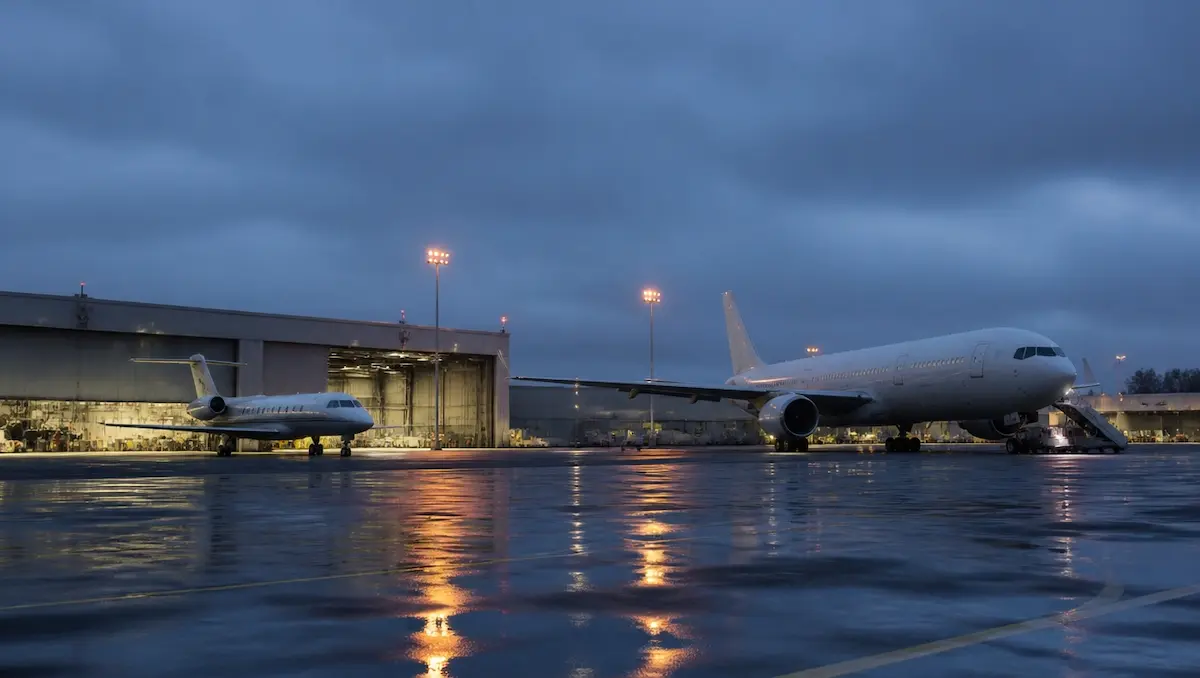
In five publishing days, the FAA issued nine airworthiness NPRMs covering 1,065 US-registered airplanes and 459 engines. Each one closes for public comment on the same Monday. The arithmetic is no coincidence, and for operators holding a Falcon or a Challenger, it is the last chance to shape a rule worth up to $300,000 per aircraft.
9 NPRMs · FAA-2026-13796 to 13813Comments close 28 December 2026US cost estimate ≈ $55.5 million
Quick Answers
| What is the “comment cliff”? | Nine separate FAA airworthiness NPRMs, published between 10 and 13 November 2026, all set a comment deadline of 28 December 2026. Nothing else about them is shared — the products run from a Boeing 787-8 to a Leonardo AW189. |
|---|---|
| Why do they all land on the same day? | Each NPRM sets a 45-day window. Adding 45 days to the three publication dates gives 25, 27 and 28 December; the Christmas holiday and the following weekend push the first two forward to Monday 28 December. |
| Are these rules in force? | No. Nothing in this list binds anyone yet. Each is a proposal, and the FAA must publish a final rule before any requirement — including the compliance times — takes effect. |
| What is the biggest one? | The Dassault Falcon MLG replacement (2026-23074). It covers 683 US airplanes; the FAA estimates that up to 178 have affected gear, and it accounts for roughly 97% of the estimated cost across all nine. |
| Does commenting on a US proposal affect the foreign AD behind it? | Not directly — but four of the nine incorporate a Transport Canada or EASA directive by reference. The FAA’s final rule requires compliance with that foreign AD “in its entirety”, so the technical content you are commenting on was written in Ottawa or Cologne. |
| Do I have to comment? | No. Whether or not you comment, a final rule will apply to you. Commenting changes the rule, not your obligation to meet it. |
| What should a small operator do this month? | Two things: confirm whether you hold an affected part number (Dassault torque links, 747-400 ACMP, A220 waste box), and diarise 28 December so the decision to comment is deliberate rather than forgotten. |
Quick Compliance Summary
- One calendar date, nine dockets. FAA-2026-13796, 13802, 13805, 13807, 13808, 13809, 13810, 13811 and 13813. Nine dockets inside an eighteen-number band is what a scheduled batch looks like, not nine unrelated decisions.
- Four incorporate a foreign directive by reference. TC AD CF-2025-71 (P&WC PW814/815), EASA AD 2026-0012 (Falcon MLG), TC AD CF-2026-26 (A220 waste box) and TC AD CF-2024-47 (Challenger 604 wing plank). The FAA is not re-deriving the technical case; it is adopting someone else’s.
- Two more are MCAI-sourced without explicit incorporation. The Diamond DA 50 C (MCAI-2026-00761-A) and AW189 (MCAI-2026-00015-R) project identifiers both signal a foreign authority as the originating source.
- Cost is concentrated, not spread. Strip out the Falcon MLG rule, and the other eight together come to roughly $1.6 million across the US fleet. The Dassault proposal alone is up to $53.9 million.
- Part-number checks beat paragraph-reading. Six of the nine turn on whether a specific part is installed — torque links, ACMP, waste box, flap actuator, SBV fuel tube, wing-skin fastener. Records are where you win or lose these.
- 28 December is a UK bank holiday. For UK-based CAMOs and continuing-airworthiness managers supporting US-registered assets, the effective filing day is Thursday 24 December, not the Monday.
- Comment quality, not volume, is what moves a rule. The FAA responds to data: fleet counts, parts availability, warranty coverage, alternative methods of compliance. “Burden” alone rarely changes an AD.
Who Should Read This
Essential: Continuing-airworthiness managers and maintenance planners on Falcon 50/2000/2000EX, Challenger 604, Boeing 747-400/400F and A220 fleets; engine programme managers for the GE Passport 20 and P&WC PW814/PW815; Part 145 organisations holding those type ratings; regulatory affairs and airworthiness review staff at operators, lessors and CAMOs.
Important: Flight-training organisations operating the DA 50 C, AW189 operators (a small population — four US helicopters — but a recurring airworthiness-limitations task), technical records teams, and anyone who maintains a compliance register that treats “NPRM” as a low-priority status.
At a Glance — the nine dockets
| FR Doc / Docket | Product and US population | Proposed action | FAA cost per unit |
|---|---|---|---|
| 2026-23198 FAA-2026-13802 | Boeing 787-8 — 14 airplanes | Inspect wing-skin penetrating fasteners with threaded nuts adjacent to EME sleeves; inspect fuel tanks, surge tanks and dry bays for unsealed nuts; accomplish the airworthiness-limitation inspection; revise the maintenance programme | $5,355 inspection; up to $18,700 concurrent work; $7,650 per operator for programme revision |
| 2026-23134 FAA-2026-13810 | Boeing 747-400 / 747-400F — 105 airplanes | Maintenance records check or inspection for AC motor pump of a certain part number; on-condition actions; prohibit installation of affected parts | Up to $255 (up to 4 work-hours) |
| 2026-23118 FAA-2026-13811 | P&WC PW814GA / PW815GA — 333 engines | Update the airworthiness limitations section of the ALM or ICA, and the approved maintenance or inspection programme, with new or more restrictive life limits | $85 (1 work-hour); $28,305 across the fleet |
| 2026-23116 FAA-2026-13813 | GE Passport 20-17BB1A / -18BB1A / -19BB1A / -19BB1B — 126 engines | Replace the start bleed valve fuel tube with the redesigned tube, following an in-flight shutdown and engine fire from a core-compartment fuel leak | $5,057 (36 work-hours + $1,997 part); $637,182 across the fleet |
| 2026-23074 FAA-2026-13805 | Dassault Mystère-Falcon 50, Falcon 2000, Falcon 2000EX — 683 airplanes, up to 178 with affected gear | Replace any affected main landing gear with a serviceable unit; limit installation of affected parts | Up to $303,060 ($3,060 labour + up to $300,000 gear). Rebuild option: $48,990 in torque-link assemblies |
| 2026-23068 FAA-2026-13809 | Diamond Aircraft DA 50 C — 30 airplanes | Inspect for displaced slide grommet and rod-end bearing fit; modify the flap actuator; repetitive torque-seal inspections; prohibit unmodified actuators; submit an execution report | $2,675 modification; $85 per inspection |
| 2026-22919 FAA-2026-13807 | Airbus Canada BD-500-1A10 / -1A11 (A220) — 32 airplanes | Supersede AD 2021-13-20: retain the waste-box corrosion inspections and add a full secondary fuel-vapour barrier for certain airplanes | $680 retained actions + $680 new actions (parts cost not established) |
| 2026-22899 FAA-2026-13808 | Bombardier CL-600-2B16 (604 variants) — 201 airplanes | Inspect the lower wing-plank rear-spar web and flange at WS 59–65, the pressure-bulkhead frame, and the fin front-spar attachment fittings for cracks; repair as required | Up to $2,040 (up to 24 work-hours); up to $410,040 across the fleet |
| 2026-22928 FAA-2026-13796 | Leonardo AW189 — 4 helicopters | Supersede AD 2024-05-07: revise the airworthiness limitations section and the approved maintenance or inspection programme | $85 (1 work-hour); $340 across the fleet |
Read the fourth column as a ranking of commercial exposure, not of safety significance. The AW189 rule at $340 exists because the FAA found new or more restrictive life limits; the 787-8 rule at $5,355 per airplane exists because fourteen aircraft may have lightning-protection fasteners installed without cap seals. Cost and consequence diverge sharply across this batch.
Why they all close on 28 December
Federal airworthiness NPRMs normally allow 45 days for comment. Three publication dates fall inside this window, and each one lands on or near the Christmas holiday:
| Published | +45 days | Actual deadline | Reason for the shift |
|---|---|---|---|
| 10 November (A350 correction window; A220, Challenger, AW189 NPRMs) | 25 December | 28 December | Christmas Day is a federal holiday; 26–27 December is a weekend |
| 12 November (Falcon, Diamond NPRMs) | 27 December | 28 December | 27 December is a Sunday |
| 13 November (787-8, 747-400, P&WC, GE Passport NPRMs) | 28 December | 28 December | No shift needed |
So the cliff is arithmetic, not policy. It is also a trap: the window is 45 days for every document, which means the effective reading time for an operator is three working days shorter than the calendar suggests — 24, 25 and 28 December are all non-working days in the UK, and 25 December is a US federal holiday.
The nine, briefly
Boeing 787-8 wing-skin fasteners — 2026-23198
This is the third 787 airworthiness action in eleven days, after the low-range radio altimeter cable AD on 9 November and the centre fuel-tank sealant AD on 2 November. The unsafe condition is specific: outer-mould-line penetrating fasteners installed with threaded nuts but no cap seals do not reliably protect against ignition sources when struck by direct attachment lightning currents. The proposal requires inspection between specific ribs on both wings for fasteners with threaded nuts adjacent to the electromagnetic-effects sleeve, plus inspection of the wing fuel tanks, surge tanks, and dry bays for threaded nuts on fasteners that penetrate the upper and lower wing skins. It also imports an airworthiness-limitation inspection and requires revising the maintenance programme to include that task. Fourteen US airplanes is a small population — this is a design-standard question dressed as a fleet directive, which is exactly the kind of NPRM worth a technical comment.
Boeing 747-400 / 747-400F AC motor pump — 2026-23134
Prompted by an overheated alternating current motor pump that caused a fire in the main landing gear wheel well. Compliance is essentially a records exercise: check maintenance records, or inspect, for an installed ACMP of a certain part number, then apply on-condition actions. The proposal also prohibits installing affected parts. At up to four work-hours and $255 per airplane, the labour is trivial — the risk sits in the on-condition replacement cost the FAA says it cannot estimate. For an ageing, increasingly part-constrained freighter fleet, the parts-prohibition paragraph matters more than the inspection.
P&WC PW814GA / PW815GA life limits — 2026-23118
The manufacturer revised the airworthiness limitations section of the airworthiness limitations manual to introduce new or more restrictive limits and intervals for life-limited parts. The FAA’s remedy is administrative: update the ALS and the approved maintenance or inspection programme. $85 per engine, 333 engines. Do not mistake the low cost for low consequence — an ALS revision can retire a life-limited part earlier than a shop visit plan assumes, and that is a scheduling problem, not a paperwork one.
GE Passport 20 start bleed valve fuel tube — 2026-23116
The strongest safety narrative in the batch. An engine in-flight shutdown followed an engine fire caused by fuel leakage inside the core compartment; the fix is a redesigned start bleed valve fuel tube. 126 engines on US-registered aircraft, $5,057 per engine including $1,997 in parts. Passport 20 powers the G500 and G600, so the affected population is business aviation with a high proportion of managed fleets — the operators most likely to want a coordinated comment on parts availability and lead time rather than a technical one.
Dassault Falcon main landing gear — 2026-23074
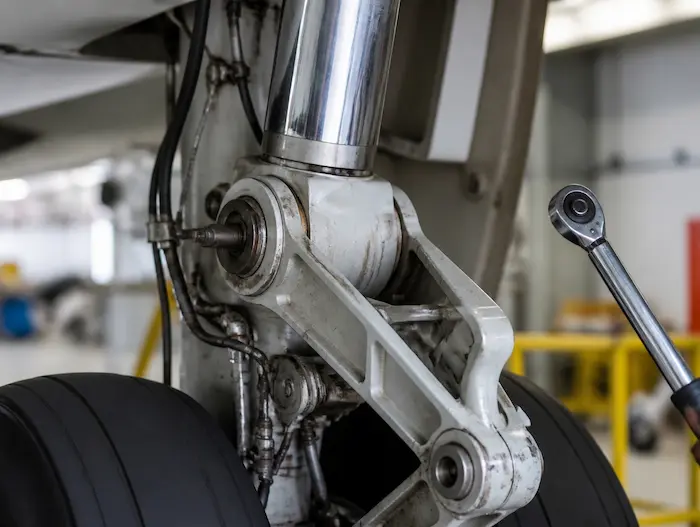
The largest item by an order of magnitude, and the most interesting legally. The FAA describes a “reported quality escape”: high-temperature oxidation of the main landing gear upper and lower torque links may have occurred during manufacturing. The proposed action is to replace the affected gear with a serviceable unit. Cost is up to $303,060 per airplane — $3,060 labour plus up to $300,000 for a new MLG — against a rebuild path at $48,990 in torque-link assemblies. The FAA estimates up to 178 of the 683 US airplanes have an affected part, giving a worst case of $53,944,680. It also notes that the manufacturer says some or all of the cost may be covered under warranty.
That last sentence is the comment hook. A quality escape is a manufacturing-fault AD, and the difference between “replace the gear” and “replace the torque links” is a quarter of a million dollars per aircraft. Operators who can document that the oxidation is confined to the torque links have a documented, costed alternative — and 28 December is when it has to be on the docket.
Diamond DA 50 C flap actuator — 2026-23068
Prompted by reports of flap actuator failures. The proposal is a four-part remedy: inspect for displacement of the black slide grommet, inspect the rod-end bearing for a tight fit, modify the actuator, and then inspect repetitively for a broken torque seal on the jam nuts. Installation of unmodified actuators is prohibited, and the rule requires an execution report to be submitted. Thirty airplanes. For a flight-training fleet, the repetitive inspection is the real cost — $85 each time, indefinitely, on an aircraft that flies a lot of cycles.
Airbus Canada A220 waste box — 2026-22919
A supersedure of AD 2021-13-20. The existing rule requires inspecting the waste box, waste access doubler and waste service door for corrosion. The FAA has now determined that a full secondary fuel-vapour barrier must be applied, so the proposal retains the old requirements and adds an inspection for certain airplanes. 32 US airplanes, $680 for retained actions and $680 for new actions, with parts cost not established. This one follows Transport Canada, and it is the cleanest illustration in the batch of how a foreign authority’s finding becomes a US obligation.
Bombardier Challenger 604 wing plank — 2026-22899
Cracks found in the lower wing plank at the rear spar, wing station 59 to 65, in the web and/or flange. The proposal requires inspections of the lower wing plank rear-spar web and lower flange, the forward surface of the pressure-bulkhead frame under the stiffeners, and the vertical stabiliser front-spar to frame attachment fitting lower legs — then repair or rectification. 201 US airplanes at up to 24 work-hours and $2,040 each. The FAA labels it an interim action, which means a terminating action is expected later: operators should plan the inspection as the first of two compliance events, not the only one.
Leonardo AW189 airworthiness limitations — 2026-22928
Supersedes AD 2024-05-07 to introduce new or more restrictive airworthiness limitations, requiring the ALS of the maintenance manual or ICA and the approved programme to be revised. Four US helicopters, $85 each. Small in money, but an ALS revision on a helicopter type is a life-limited-part event for the operator, and four aircraft is a population where a single operator’s comment carries weight.
The money, in one table
| NPRM | Estimated cost on US operators | Share of batch |
|---|---|---|
| 2026-23074 Dassault Falcon MLG | Up to $53,944,680 | 97.2% |
| 2026-23116 GE Passport SBV fuel tube | $637,182 | 1.1% |
| 2026-22899 Challenger 604 wing plank | Up to $410,040 | 0.7% |
| 2026-23198 Boeing 787-8 fasteners | Up to $336,770 plus $7,650 per operator | 0.6% |
| 2026-23068 Diamond DA 50 C | $82,800 plus repetitive inspections | 0.1% |
| 2026-22919 A220 waste box | $43,520 | 0.1% |
| 2026-23134 Boeing 747-400 ACMP | Up to $35,700 | <0.1% |
| 2026-23118 P&WC PW814/PW815 ALS | $28,305 | <0.1% |
| 2026-22928 Leonardo AW189 ALS | $340 | <0.1% |
| Total | ≈ $55.52 million | 100% |
These are the FAA’s own estimates, which exclude on-condition repairs it says it cannot size — so the true figure is higher, particularly on the 747-400 and the A220. Treat the total as a floor, and treat the concentration as the story: one business-aviation gear rule is worth more than the other eight combined by a factor of thirty.
How to comment so that it counts
- Use the docket number, not the document number. Comments go to regulations.gov against the FAA docket (FAA-2026-13802 for the 787-8, and so on). The Federal Register document number identifies the notice; the docket is where the record lives.
- Lead with data the FAA does not have. Fleet counts by serial number, actual parts lead times, warranty coverage, or a costed alternative action. Every one of these nine NPRMs contains at least one place where the FAA says it has “no definitive data” — the 747-400 on-condition cost, the A220 parts cost, the Dassault proportion of affected aircraft.
- If you are challenging a foreign AD, say so explicitly. For the four that incorporate TC or EASA directives, the FAA’s position is that it is adopting the foreign rule in its entirety. A comment that attacks the underlying technical finding without addressing the incorporation will be answered with the incorporation.
- Ask for the compliance time you can actually meet, with evidence. Parts scarcity is the argument the FAA has accepted before and rejected before; what decides it is a dated manufacturer quote, not a general statement of concern.
- If you need more time, ask early. There is no automatic extension. A request filed in the last week of December is competing with a holiday docket, and the FAA grants extensions at its discretion.
- Do not skip a rule because the dollar figure is small. The AW189 and P&WC items are $85 per unit, but both are airworthiness-limitation revisions — the kind of change that alters a maintenance programme rather than adding a one-off task.
What happens after 28 December
Nothing automatic. The FAA is not obliged to publish a final rule by any date, and the interval between NPRM and final rule on airworthiness actions is typically measured in months, not weeks. Three things are worth watching:
- Comment disposition. The final rule must address significant comments, and where the FAA changes its position it usually says so in the preamble. A comment that produces a cost revision is visible in the final rule’s cost table.
- Supersedure risk. The A220 and AW189 proposals already supersede earlier ADs. If the underlying manufacturer document is revised again before the final rule, a third supersedure is possible, and the compliance baseline moves again.
- Foreign-side movement. For the four MCAI-based actions, a revision to the Transport Canada or EASA directive after 28 December effectively re-opens the US rule, whether or not anyone commented.
Dates that matter
| Date | Event |
|---|---|
| 13 November 2026 | Last of the nine NPRMs published (787-8, 747-400, P&WC, GE Passport) |
| 24 December 2026 | Practical filing date for UK and EU-based organisations — 25, 26 and 28 December are non-working days |
| 25 December 2026 | US federal holiday |
| 28 December 2026 | Comments close on all nine dockets (also a UK bank holiday — Boxing Day substitute) |
| 12 January 2027 | Comments close on the DJT/West Palm Beach Class C airspace NPRM and the Part 36 noise-certification information collection — separate dockets, not part of this batch |
| 11 January 2027 | Unrelated but adjacent: FAA final rule 2026-22953 on inspection programmes for single-engine turbine airplanes and UAS takes effect |
Frequently asked questions
Is 28 December a hard deadline?
Yes, for the comment record. The FAA can and does consider late comments at its discretion, but a late filing has no procedural standing and is routinely noted as such in the final rule preamble. Treat the date as hard
Do I need to comment on all nine?
No. Comment on the ones where you hold the affected product or where you can supply data the FAA lacks. For most operators, that is one or two dockets, not nine.
Will a comment delay the rule?
It can, but only by raising a genuine issue the FAA must resolve. Substantive comments on cost, parts availability, or alternative means of compliance change timelines and text. Volume without new information does not.
What if I only operate the aircraft under an EASA approval?
Then these FAA dockets do not bind you directly — but four of the nine adopt a Transport Canada or EASA directive you may already be subject to, and the FAA action often lands before the European or Canadian equivalent is amended. The FAA is, on the A220 and Challenger items, running ahead of Transport Canada rather than behind it
Where do I find the proposed compliance times?
In the proposed regulatory text at the end of each NPRM, not in the summary. For the four that incorporate a foreign directive by reference, the operative times are in the incorporated Transport Canada or EASA AD, which is why reading only the FAA preamble leaves you without a deadline.
Sources
- FAA, Airworthiness Directives; The Boeing Company Airplanes (787-8), NPRM, 13 November 2026 — FR Doc. 2026-23198, Docket FAA-2026-13802.
- FAA, Airworthiness Directives; The Boeing Company Airplanes (747-400/-400F), NPRM, 13 November 2026 — FR Doc. 2026-23134, Docket FAA-2026-13810.
- FAA, Airworthiness Directives; Pratt & Whitney Canada Corp. Engines, NPRM, 13 November 2026 — FR Doc. 2026-23118, Docket FAA-2026-13811.
- FAA, Airworthiness Directives; General Electric Company Engines, NPRM, 13 November 2026 — FR Doc. 2026-23116, Docket FAA-2026-13813.
- FAA, Airworthiness Directives; Dassault Aviation Airplanes, NPRM, 12 November 2026 — FR Doc. 2026-23074, Docket FAA-2026-13805.
- FAA, Airworthiness Directives; Diamond Aircraft Industries GmbH Airplanes, NPRM, 12 November 2026 — FR Doc. 2026-23068, Docket FAA-2026-13809.
- FAA, Airworthiness Directives; Airbus Canada Limited Partnership Airplanes, NPRM, 10 November 2026 — FR Doc. 2026-22919, Docket FAA-2026-13807.
- FAA, Airworthiness Directives; Bombardier, Inc., Airplanes, NPRM, 10 November 2026 — FR Doc. 2026-22899, Docket FAA-2026-13808.
- FAA, Airworthiness Directives; Leonardo S.p.a. Helicopters, NPRM, 10 November 2026 — FR Doc. 2026-22928, Docket FAA-2026-13796.
- UK Government, UK bank holidays — 28 December 2026 listed as the Boxing Day substitute day.
All fleet counts, cost figures, and docket numbers in this article come from the Federal Register API record and the full text of each NPRM as published. Cost figures are the FAA’s estimates and exclude on-condition repairs the agency says it cannot size. Nothing in this article is legal advice; confirm applicability against the published regulatory text before acting.