Quick Compliance Summary
| Affected aircraft | Bombardier BD-700-1A10, BD-700-1A11, BD-700-2A12 |
| Issue | Seat frames assembled without required Loctite threadlocker at specified fastener locations |
| Required action | Modify non-locking fastener joints on affected seat frame assemblies |
| Compliance deadline | July 20, 2026 |
| Who must act | Operators, CAMOs, MROs supporting affected BD-700 fleets |
| Source | FAA AD 2026-11-07 — Docket No. FAA-2026-2279 |
Who Should Read This
This update is directly relevant to:
- Directors of Maintenance
- Continuing Airworthiness Managers (CAMs)
- Part 135 Operators
- Part 91K Fractional Operators
- Bombardier Authorized Service Centers
- MRO Planning Teams
If your organization operates, maintains, or manages airworthiness for any BD-700 series aircraft on the US register, this AD requires action before July 20, 2026.
At a Glance
| Item | Details |
|---|---|
| AD Number | 2026-11-07 |
| Amendment | 39-23368 |
| Docket | FAA-2026-2279 |
| ATA Code | 25 — Equipment/Furnishings |
| Aircraft | BD-700-1A10, BD-700-1A11, BD-700-2A12 |
| Effective Date | July 20, 2026 |
| Required Action | Seat frame fastener joint modification |
| Unsafe Condition | Missing Loctite threadlocker on seat frame fasteners |
| Originating Authority | Transport Canada (AD CF-2025-41, August 20, 2025) |
| Compliance Time | Before effective date — no grace period |
What Changed

The FAA published AD 2026-11-07 in the Federal Register on June 15, 2026. It adds a new entry to 14 CFR Part 39 requiring modification of non-locking fastener joints on the seat frame assemblies of certain Bombardier BD-700 series aircraft.
The AD mirrors Transport Canada AD CF-2025-41, issued August 20, 2025. The FAA reviewed the mandatory continuing airworthiness information (MCAI) and issued a corresponding directive for US-registered aircraft — a standard bilateral adoption under the FAA–Transport Canada airworthiness agreement.
Why It Matters
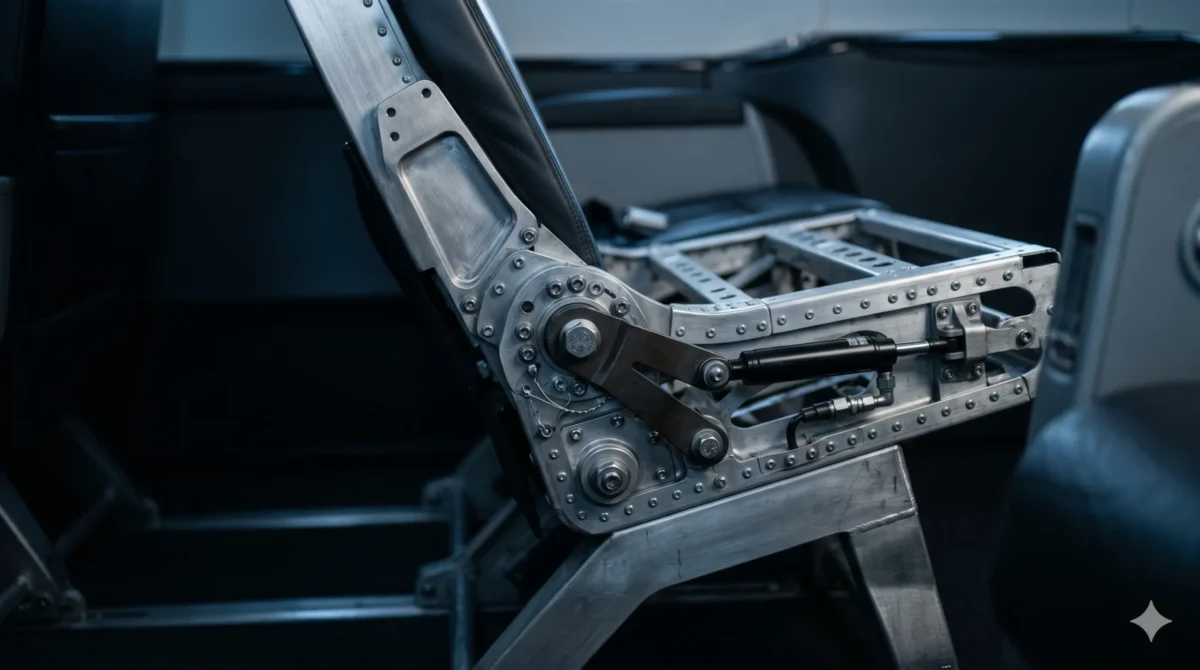
Certain BD-700 seat frames were assembled without Loctite threadlocker applied at specified screw locations. Without it, the fastener joints in the seat frame assembly can lose structural integrity under normal operational loads.
The failure risk is not abstract. It directly affects two safety-critical systems:
- Lap belt attachment — structural failure here compromises occupant restraint
- Seat backrest locking mechanism — failure here creates a risk of seat collapse under acceleration or impact loads
These are not cosmetic concerns. Both systems are occupant safety items. The FAA classifies this as an unsafe condition requiring mandatory corrective action.
Who Is Affected
The AD applies to Bombardier BD-700-1A10, BD-700-1A11, and BD-700-2A12 airplanes certificated in any category, as identified in Transport Canada AD CF-2025-41.
These models cover the entire Bombardier Global Express family:
| Model Designation | Aircraft Type |
|---|---|
| BD-700-1A10 | Global Express, Global 5000 |
| BD-700-1A11 | Global 6000 |
| BD-700-2A12 | Global 7500 |
Aircraft on the Canadian register were already subject to Transport Canada CF-2025-41 since August 2025. This FAA AD covers US-registered aircraft in the same fleet population.
Required Action
Operators must modify the non-locking fastener joints of the seat frame assembly on affected aircraft before July 20, 2026. The modification must be carried out using an approved method referenced in the AD.
Confirm the specific serial number applicability against the scope defined in Transport Canada AD CF-2025-41. Not all aircraft in production may be affected — the issue relates to a specific assembly practice during manufacturing.
If using a DAO-authorized organization, ensure the modification is completed and signed off with an appropriate DAO-authorized signature before the effective date.
Operational Impact
Operators should review scheduled maintenance windows between now and July 20, 2026.
The modification is a seat frame fastener intervention — not a heavy maintenance item — but it requires access to the seat assemblies, which may result in cabin downtime depending on the configuration.
For high-utilization aircraft, coordinate early with your Bombardier Authorized Service Center or DAO-authorized MRO. Capacity at approved facilities may tighten as the deadline approaches, particularly if the fleet population affected is larger than initially apparent after serial number confirmation.
Aircraft operated under Part 135 or Part 91K that remain unmodified after July 20, 2026 may not be legally dispatched. Build the AD into your maintenance planning cycle now.
Key Dates
| Event | Date |
|---|---|
| Transport Canada AD CF-2025-41 issued | August 20, 2025 |
| FAA AD 2026-11-07 published | June 15, 2026 |
| Compliance deadline / AD effective date | July 20, 2026 |
Source Documents
- Federal Register Vol. 91, No. 114, June 15, 2026 — FR Doc 2026-11976
- Transport Canada AD CF-2025-41 — available at tc.canada.ca/en/aviation
- AD Docket: regulations.gov, Docket No. FAA-2026-2279
Bombardier BD-700 Seat Frame Modification: FAQ
Does this AD apply to aircraft on the Canadian register?
No. Canadian-registered aircraft were already subject to Transport Canada AD CF-2025-41 since August 2025. FAA AD 2026-11-07 applies to US-registered aircraft only.
Is this an inspection AD or a modification AD?
It is a modification AD. The required action is modification of the non-locking fastener joints — not a one-time inspection followed by continued operation.
What happens if we operate an affected aircraft after July 20, 2026 without completing the modification?
Operating a US-registered aircraft in violation of an AD constitutes a violation of 14 CFR 39.7. This creates significant enforcement exposure for the operator and the responsible maintenance organization.
Where do we confirm which serial numbers are affected?
Applicability is determined by reference to Transport Canada AD CF-2025-41, dated August 20, 2025. The scope of serial numbers is defined in that document. Contact your Bombardier service representative if serial number applicability is unclear.
aviationregwatch.com publishes regulatory intelligence for aviation compliance professionals. This article is an informational summary, not legal or airworthiness advice. Consult your airworthiness authority or legal counsel for compliance decisions.