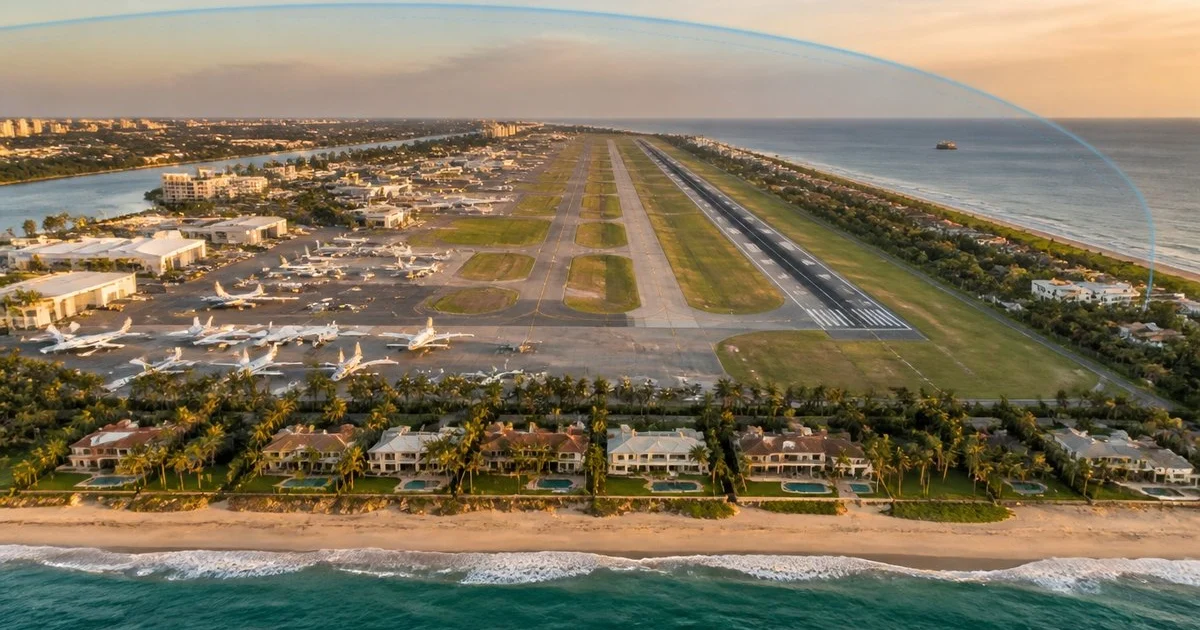
Published in the Federal Register September 2, 2026 · docket FAA-2026-10827 · 14 CFR Part 93 (Special Air Traffic Rules / SFRA) · 30-day comment period
Quick Answers
What is proposed? The FAA proposes implementing Special Air Traffic Rules in the airspace around President Donald J. Trump International Airport (DJT, formerly Palm Beach International/PBI), creating a Special Flight Rules Area (SFRA).
Why? The US Secret Service (USSS) requested the FAA restrict aircraft operations in the vicinity of President Trump’s Florida non-governmental property to safeguard USSS protectees in the interest of national security. The request also drew on Public Law 94-524 (1976), which enables the President to designate one non-governmental property to be secured by USSS on a permanent basis.
Who is affected? Any aircraft operator flying in the DJT SFRA — including GA, charter, flight training, drones and commercial arrivals/departures at DJT. The proposal is designed to keep normal airport operations flowing while restricting operations within the SFRA unless conditions are met (e.g. an approved plan/authorization).
When? Comments close October 2, 2026 on docket FAA-2026-10827. The rule itself would only bind after a final rule is published (effective date to follow).
Quick Compliance Summary
| Field | Detail |
|---|---|
| Regulatory body | Federal Aviation Administration (FAA) |
| Instrument | NPRM — Establishment of Special Air Traffic Rules in the vicinity of President Donald J. Trump International Airport (14 CFR Part 93) |
| Status | Proposed — comments due October 2, 2026 |
| Published | September 2, 2026 (Federal Register) |
| Docket | FAA-2026-10827 (regulations.gov) |
| Trigger | US Secret Service request (Sept 16, 2025 letter from USSS Director Sean M. Curran) to secure the President’s Florida non-governmental property |
| Airport | President Donald J. Trump International Airport (DJT), formerly Palm Beach International (PBI); new ICAO/IATA code DJT effective July 9, 2026 |
| Legal hook | Special Flight Rules Area per 14 CFR Part 93; Public Law 94-524 (1976) permanent USSS-secured property designation |
| Comment deadline | October 2, 2026 |
Who Should Read This
- GA pilots and flight schools in South Florida — SFRA entry/exit, communications, and authorization requirements could change your local flying
- Part 135 charter and air ambulance operators — SFRA routing and operational approvals
- Drone/UAS operators — SFRA typically restricts small-UAS operations inside the area
- Airline network planning / dispatchers serving DJT (PBI) — the NPRM aims to keep scheduled operations viable while securing the airspace
- Aviation legal/compliance teams — comment period is the window to shape the final rule
At a Glance
| Item | Detail |
|---|---|
| Rule type | NPRM — Special Air Traffic Rules / SFRA (14 CFR Part 93) |
| Area | Airspace in the vicinity of DJT (formerly PBI), Florida |
| Radio identifier | DJT (new airport code effective July 9, 2026) |
| Requesting agency | US Secret Service (letter dated Sept 16, 2025) |
| Statutory basis | Pub. L. 94-524 (1976) — one non-governmental property permanently secured by USSS |
| Comment deadline | October 2, 2026 |
| Effective date | To follow final rule |
What This Would Do
If adopted, the proposal creates a Special Flight Rules Area around DJT in which aircraft operations would be restricted unless certain conditions are met. Special Air Traffic Rules (SATR) are non-standard rules applicable within designated airspace, defined in 14 CFR Part 93 and described in the Aeronautical Information Manual (3-5-7) and AIP ENR 5.1 (2.4). Typical SFRA features include designated entry/exit gates, transponder/communication requirements, and advance authorization for non-commercial operations.
The FAA’s stated design intent is to avoid a blanket closure that would “severely restrict normal airport operations” — the proposal is structured to keep commercial flights operating at DJT while securing the nearby residential property. Operators of affected airspace users would need to meet specific requirements, including (per industry reporting) an approved flight/authorization plan for access.
What it does NOT do
- It does not close the airport or ban commercial operations — the NPRM explicitly seeks to preserve airport viability.
- It does not yet impose any obligation — the SFRA binds only after the final rule.
- It does not change the applicable TFR/security rules outside the described SFRA boundaries.
Why This Exists Now
Following the airport’s renaming (the DJT code took effect on July 9, 2026), the USSS formally requested (in a letter dated Sept 16, 2025) that the FAA restrict aircraft operations near the President’s non-governmental property in Florida. The legal foundation is Public Law 94-524 (Oct 17, 1976), which enables the President to designate one non-governmental property to be fully secured by the Secret Service on a permanent basis — the property at issue here. The FAA’s rulemaking translates that security requirement into an enforceable airspace instrument, consistent with the existing framework of Special Air Traffic Rules and SFRAs (e.g., the Washington, DC SFRA created under the same authority framework).
Operational Impact Matrix
| Affected function | Action required | Deadline / driver | Reference |
|---|---|---|---|
| GA / flight training (South Florida) | Comment on SFRA scope, entry/exit, and authorization burden | Oct 2, 2026 | Docket FAA-2026-10827 |
| Part 135 / charter / air ambulance | Assess routing and authorization impact; comment | Oct 2, 2026 | Docket FAA-2026-10827 |
| Drone / UAS operators | Confirm whether the SFRA extends to small-UAS ops; comment on carve-outs | Oct 2, 2026 | Docket FAA-2026-10827 |
| Airlines / dispatchers (DJT) | Track final-rule requirements for continued operations | Post-final | Final rule (to follow) |
Cost & Benefit
| Item | Estimate |
|---|---|
| Compliance mechanism | Authorization/approval for affected operators (likely administrative, not capital-intensive) |
| Avoided cost | Preserving normal airport operations avoids the substantial economic disruption of a closure or long-duration TFR regime |
| USSS/public interest | National-security benefit for protectee security (non-quantified) |
Final cost figures will appear in the final-rule preamble; the NPRM’s framework is authorization-based rather than equipment- or retrofit-based.
What Operators Should Do Now
- Pull the NPRM text and diagram from the docket (FAA-2026-10827) and check whether your operating area falls inside the proposed SFRA.
- File comments before October 2, 2026 — especially GA/drone/charter operators exposed to the authorization process.
- Draft internal procedures for future SFRA entry/exit and authorization (mirroring the DC SFRA pattern) so you’re ready when the final rule lands.
- For drone operators: assess whether your UAS geofencing vendors already model the proposed SFRA.
Compliance Checklist
- NPRM owner assigned; comment drafted on docket FAA-2026-10827
- Proposed SFRA boundary mapped against your operating area
- Authorization/approval pathway assessed (GA, charter, drone)
- Internal SFRA ops procedure drafted (modeled on DC SFRA best practice)
ARW take: this is a political-security airspace rule with a practical aviation footprint. Expect the final SFRA to closely track the DC SFRA design language — gated entry/exit, authorization for non-commercial traffic, low-altitude/UAS restriction — because it is being built on the same legal foundations (Pub. L. 94-524) and the same USSS request template. The commercial-airport preservation angle is the key design tension: operators serving DJT should comment on how the SFRA interacts with standard instrument procedures and traffic patterns, because that is where a poorly scoped rule creates real operational drag. The comment window (30 days, closing Oct 2) is short — file early.
Key Dates
| Milestone | Date |
|---|---|
| Airport renamed; DJT code effective | July 9, 2026 |
| USSS request letter (Director Sean M. Curran) | September 16, 2025 |
| NPRM published | September 2, 2026 |
| Comments due | October 2, 2026 |
| Final rule / SFRA effective | [CONFIRM: after comment review] |
Source Documents
- Federal Register — Establishment of Special Air Traffic Rules in the Vicinity of President Donald J. Trump International Airport (NPRM, Sep 2, 2026)
- FAA — Recently Published Rulemaking Documents (comment deadline Oct 2, 2026)
- Docket — FAA-2026-10827 (regulations.gov)
- Background — Public Law 94-524 (Oct 17, 1976)
FAQ
Does this close the airport? No. The proposal is structured to keep commercial operations flying while restricting other operations in the SFRA unless conditions are met.
Is this already in force? No — it is an NPRM. Nothing changes until a final rule is published and effective.
Does it affect drones? Almost certainly within the SFRA, subject to the final-rule details — drone operators should comment on carve-outs and geofencing requirements.
How does it relate to the DC SFRA? Same legal and procedural framework (14 CFR Part 93 Special Air Traffic Rules; Pub. L. 94-524 security designation), which is the best blueprint for expected final-rule features.
Related Reading:
- FAA NPRM: Improving Emergency Medical Kit Efficacy and Flexibility in Commercial Airline Operations PROPOSED — COMMENTS DUE OCTOBER 5, 2026
- FAA AD 2026-15-11: Boeing 737 MAX Fuselage Skin and Bear Strap Inspections EFFECTIVE SEPTEMBER 10, 2026
- FAA AD 2026-15-10: Airbus A330neo Wing Sloping Rib Cracking — Repetitive Inspections Required
- FAA AD 2026-17-03: IAE V2500-A5 Engines — 3rd Stage HPC Rotor Blade Replacement
- FAA Rescinds CE-500 Single-Pilot Exemptions: What Changes
aviationregwatch.com publishes regulatory intelligence for aviation compliance professionals. This article is an informational summary compiled from the sources listed above, not legal advice. Verify against the primary source (FR doc. 2026-17957) and the docket before acting.