
Quick Reading
What does FAA AD 2026-10-14 require for Boeing 747 operators?
FAA AD 2026-10-14, effective July 6, 2026, requires repetitive detailed inspections of the SATCOM high-gain antenna adapter plate on all Boeing 747-100 through 747-400 series aircraft for corrosion. If corrosion is found, corrective actions must be completed on condition. All 747 variants except the 747-8 are in scope.
Why is corrosion on the SATCOM antenna of a Boeing 747 a safety issue?
Corrosion on the SATCOM high-gain antenna adapter plate can cause the plate and attached components to lose structural integrity and depart the aircraft in flight. Parts departing an aircraft can cause damage resulting in loss of continued safe flight and landing — making this a structural safety risk, not just a communications issue.
Quick Compliance Summary
| Regulatory body | Federal Aviation Administration (FAA) |
| AD number | 2026-10-14 — Amendment 39-23354 |
| Docket | FAA-2025-3422 |
| Aircraft affected | All Boeing 747-100, -100B, -100B SUD, -200B, -200C, -200F, -300, -400, -400D, -400F, 747SP, and 747SR series airplanes |
| Issue | Corrosion damage on the SATCOM high-gain antenna adapter plate |
| Required action | Repetitive detailed inspections of the SATCOM high-gain antenna adapter plate for corrosion. On-condition actions if required |
| Compliance deadline | July 6, 2026 — already effective |
| Who must act | Operators, CAMOs, MROs supporting 747 fleets |
| Source | Federal Register — FR Doc 2026-10803, Docket No. FAA-2025-3422 |
Who Should Read This
This update is directly relevant to:
- Directors of Maintenance for 747 operators
- Continuing Airworthiness Managers (CAMs) managing 747 fleets
- Part 145 MRO organizations with 747 maintenance capability
- Freighter operators (particularly 747-200F, -400F variants)
- Aircraft lessors with 747 assets
Every variant in the 747 family — passenger, freighter, combi, and special — is in scope. There are no model exceptions.
At a Glance
| Item | Details |
|---|---|
| AD Number | 2026-10-14 |
| Amendment | 39-23354 |
| Docket | FAA-2025-3422 |
| ATA Code | 23 — Communications |
| Aircraft | All 747-100, -100B, -100B SUD, -200B, -200C, -200F, -300, -400, -400D, -400F, 747SP, 747SR |
| Effective Date | July 6, 2026 |
| Required action | Repetitive detailed inspections of SATCOM high-gain antenna adapter plate for corrosion |
| Unsafe condition | Corroded parts departing the aircraft, causing damage and potential loss of safe flight and landing |
| On-condition action | Required if corrosion found |
| Originating trigger | Reports of corrosion damage found on SATCOM adapter plates |
What Changed
The FAA published AD 2026-10-14 on May 29, 2026. It became effective July 6, 2026.
Multiple reports of corrosion damage on SATCOM high-gain antenna adapter plates prompted the AD. The SATCOM high-gain antenna adapter plate is a structural fitting that connects the antenna assembly to the aircraft skin.
The 747 fleet is aging. The oldest variants in scope date from the early 1970s. Corrosion management on aging structures is a known and growing compliance challenge across the 747 population — this AD adds a specific SATCOM-related inspection to that picture.
Why It Matters
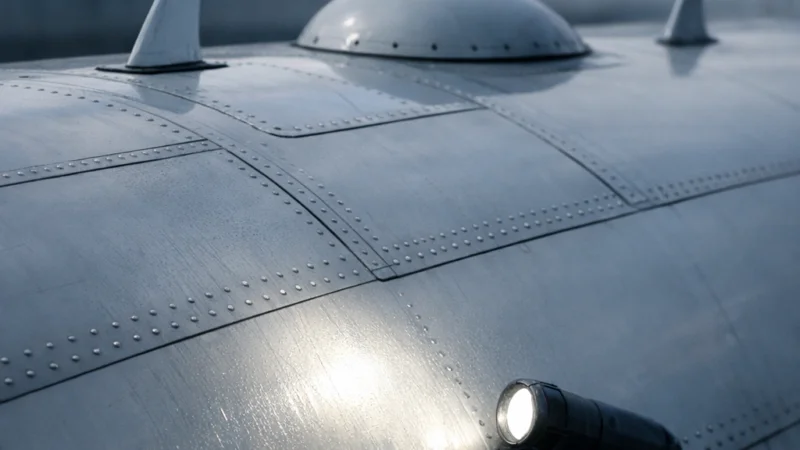
Close-up of a commercial aircraft upper fuselage exterior surface,
inspector’s work light casting a focused beam on the skin panel, antenna
fairings visible on the fuselage crown, no airline branding, photorealistic,
editorial aviation maintenance photography style, cool grey tones,
no legible text, no people, no faces
The risk here is straightforward and serious.
Corrosion on the SATCOM high-gain antenna adapter plate can cause the plate — and the components attached to it — to lose structural integrity. Corroded parts can then depart the aircraft.
Parts departing an aircraft in flight can cause damage. That damage could result in loss of continued safe flight and landing.
This is not a communications-only risk. It is a structural and safety-of-flight risk.
Who Is Affected
All Boeing 747 series airplanes, certificated in any category, are in scope. No variant exceptions exist.
The scope covers:
| Variant group | Models |
|---|---|
| Classic freighter/combi | 747-100, -100B, -100B SUD, -200B, -200C, -200F, -300, 747SP, 747SR |
| 747-400 family | 747-400, -400D, -400F |
For freighter operators — particularly those still flying 747-200F and 747-400F variants — this is an active compliance item. Freighter conversions and older 747 airframes are the most likely population to carry older SATCOM installations with aging adapter plates.
Required Action
Perform repetitive, detailed inspections (DETs) of the SATCOM high-gain antenna adapter plate for corrosion.
Inspection compliance times, intervals, and on-condition actions are specified in the service information incorporated by reference in the AD.
If corrosion is found: Complete the applicable on-condition actions before returning the aircraft to service. The on-condition actions are defined in the referenced service documentation.
Obtain the applicable service document through Boeing or your type certificate holder to confirm the specific inspection threshold, repeat interval, and on-condition procedures for your aircraft serial number.
Operational Impact
The 747 fleet on the US registry is aging. Compliance management for this AD should be folded into existing structural aging aircraft programs rather than treated as a standalone task.
For operators running 747-400 freighters with high cycles, confirm the SATCOM adapter plate inspection has not already been triggered under a previous service bulletin or operator-specific aging aircraft program. If it has, document that work and confirm it satisfies the AD compliance threshold.
For operators with older 747 classics still in service — particularly 747-200F variants — the adapter plate may be significantly aged. Treat the initial inspection as a priority before confirming compliance intervals.
MRO planning teams should add this inspection to the next scheduled 747 maintenance visit for all affected aircraft. The AD does not create a standalone aircraft-on-ground event — it is designed to be accomplished during scheduled maintenance.
Key Dates
| Event | Date |
|---|---|
| FAA AD 2026-10-14 published | May 29, 2026 |
| AD effective date | July 6, 2026 |
Source Documents
- Federal Register — FR Doc 2026-10803 (AD 2026-10-14)
- AD Docket: regulations.gov, Docket No. FAA-2025-3422
- Boeing service documentation — obtain through Boeing Technical Support or your type certificate holder
FAQ
Does this AD apply to 747-8 variants?
No. The AD applicability is limited to 747-100 through 747-400 series, 747SP and 747SR. The 747-8 is not listed in the applicability.
Is this a one-time inspection or a recurring one?
Repetitive. The AD requires repeated detailed inspections at intervals specified in the referenced service documentation — not a single inspection followed by close-out.
What is the SATCOM high gain antenna adapter plate?
It is the structural fitting that connects the SATCOM high-gain antenna assembly to the aircraft fuselage skin. It is a load-bearing connection point. Corrosion of this plate undermines the structural integrity of the antenna installation.
Can the inspection be done during scheduled maintenance?
Yes. The AD is designed to be accomplished during scheduled maintenance visits. No dedicated aircraft-on-ground event is required solely for this inspection.
What on-condition actions are required if corrosion is found?
On-condition actions are defined in the Boeing service documentation incorporated by reference in the AD. Obtain the applicable document through Boeing or your type certificate holder. The specific repair or replacement procedure depends on the extent and location of the corrosion found.
Does this AD affect 747 freighter operators differently from passenger operators?
The AD applies identically to all variants. However, older 747-200F and 747-400F freighter airframes are more likely to have aged SATCOM adapter plates and may require more attention at the initial inspection.
Related Reading:
- FAA AD 2026-13-11: Boeing 787 Dreamliner 5G Canadian Airspace Limitations — Effective July 1, 2026
- FAA AD 2026-13-13: Boeing 737 Classic and NG Family Now Subject to 5G C-Band Canadian Airspace Limitations
- FAA Issues Airworthiness Directive for Boeing 737 Classic Fuselage Crack Inspection — Effective June 17, 2026
- FAA Issues Airworthiness Directive for Airbus A330 Family Structural Unsafe Condition — Effective June 8, 2026
- FAA Issues Airworthiness Directive for Airbus H160-B Helicopter — Emergency Life-Raft System Inspection Required
aviationregwatch.com publishes regulatory intelligence for aviation compliance professionals. This article is an informational summary, not legal or airworthiness advice. Consult your aircraft manufacturer, CAMO, or legal counsel for compliance decisions.