
Quick Answer
What does FAA AD 2026-10-15 require for Airbus A320 family aircraft?
FAA AD 2026-10-15, effective July 6, 2026, requires repetitive special detailed inspections and rototest or HFEC inspections of fasteners and fastener holes at the forward pressure bulkhead of certain A318, A319, A320, and A321 aircraft. The AD addresses a cold working process deviation that reduces fastener hole fatigue life.
What cold-working deviation triggered the Airbus A320 bulkhead AD?
During a manufacturing review, Airbus detected a deviation from the specified cold working process used to strengthen fastener holes in the A320 family assembly line. The deviation reduces the fatigue life of the affected fastener holes at the forward pressure bulkhead, increasing the risk of crack initiation and compromising structural integrity.
Quick Compliance Summary
| Regulatory body | Federal Aviation Administration (FAA) |
| AD number | 2026-10-15 — Amendment 39-23355 |
| Docket | FAA-2025-2544 |
| Aircraft affected | Certain Airbus A318, A319, A320, and A321 variants (ceo and neo families) |
| Issue | Cold working process deviation during assembly reduces fatigue life at forward pressure bulkhead connection and fuselage skin at specific frames |
| Required action | Repetitive special detailed inspections and rototest/HFEC inspections of affected fasteners and fastener holes. Corrective actions if required |
| Compliance deadline | July 6, 2026 — already effective |
| US fleet affected | 1,474 airplanes on the US registry |
| Source | Federal Register Vol. 91, No. 103, May 29, 2026 — FR Doc 2026-10799 |
Who Should Read This
This update is directly relevant to:
- Continuing Airworthiness Managers (CAMs) for A318/A319/A320/A321 fleets
- Directors of Maintenance
- Part 145 MRO Planning Teams scheduling A320 family inspections
- Quality Managers at approved maintenance organizations
- Aircraft lessors managing A320 family assets
The A320 family is the world’s most numerous narrow-body fleet. If your organization operates, maintains, or manages airworthiness for any variant listed in this AD, this directive is already in effect.
At a Glance
| Item | Details |
|---|---|
| AD Number | 2026-10-15 |
| Amendment | 39-23355 |
| Docket | FAA-2025-2544 |
| ATA Code | 53 — Fuselage |
| Aircraft | Certain A318, A319, A320, A321 ceo and neo/NX variants |
| Effective Date | July 6, 2026 |
| Required action | Repetitive SDIs and rototest/HFEC inspections of affected fasteners and fastener holes |
| Unsafe condition | Reduced fatigue life at forward pressure bulkhead connection and fuselage skin |
| If cracks found | Repair before further flight |
| Originating authority | EASA AD 2025-0078, April 9, 2025 |
| US fleet affected | 1,474 airplanes |
| Cost estimate | Up to $5,355 per aircraft (63 work-hours at $85/hr) |
| Total US fleet cost | Up to $7,893,270 |
What Changed
The FAA published AD 2026-10-15 on May 29, 2026. It became effective July 6, 2026.
The AD adopts EASA AD 2025-0078, dated April 9, 2025, as its basis — a standard bilateral adoption under the FAA–EASA agreement.
The trigger was a manufacturing discovery. During a review of the cold working process on the A320 family assembly line, Airbus detected a deviation. Cold working is a process used to strengthen fastener holes in metal structures. Done correctly, it increases fatigue life. A deviation from the specified process reduces that life advantage.
The deviation affects specific locations on the forward pressure bulkhead and fuselage skin.
The FAA incorporated two operator-requested exceptions into the final AD — both of which make the inspection process more practical than the original EASA text required. These are discussed in the Required Action section below.
Why It Matters
The affected locations are structural.
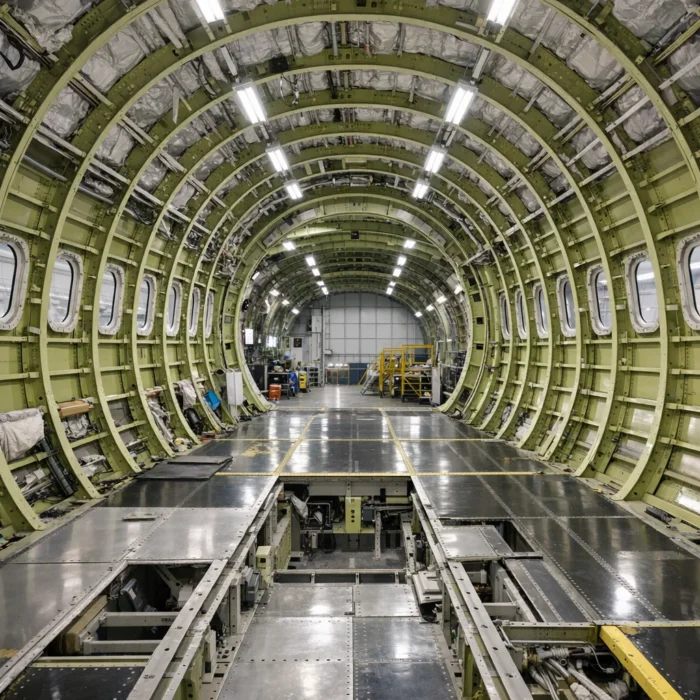
The forward pressure bulkhead separates the pressurized cabin from the unpressurized tail section. It is one of the primary load-bearing structural elements at the aft end of the pressurized fuselage. The fuselage skin at the affected frame stations carries cabin pressure loads on every flight cycle.
A deviation in the cold working process means the fastener holes in those areas have a lower fatigue life than designed. Lower fatigue life means cracks can initiate earlier than expected under normal cyclic loading.
The consequence, if not detected and corrected: crack initiation and propagation, which may reduce the airplane’s structural integrity.
This is a fatigue-driven structural risk. It is directly related to aircraft age and flight cycles, not a single event or incident. The risk grows with each additional pressurization cycle on affected aircraft.
Which Aircraft Are Affected
The AD applies to specific model variants, as identified in EASA AD 2025-0078. Not all aircraft in each family are affected — applicability is determined by production serial number.
Covered model families:
| Family | Variants covered |
|---|---|
| A318 | -111, -112, -122 |
| A319 | -111, -112, -113, -114, -115, -131, -132, -133 |
| A320 | -211, -212, -214, -216, -232, -233, -251N, -252N, -253N, -271N, -272N, -273N |
| A321 | -211, -212, -213, -231, -232, -251N, -252N, -253N, -271N, -272N, -251NX, -252NX, -253NX, -271NX, -272NX |
Check EASA AD 2025-0078 for the specific serial number applicability. The FAA estimates 1,474 US-registered airplanes are in scope.
Required Action
Comply with all required actions and compliance times specified in EASA AD 2025-0078, subject to the FAA’s exceptions below.
The inspection sequence:
- Repetitive special detailed inspections (SDIs) around the fastener holes at frame FR35 (A319 and A320) and FR35.8 (A321), between stringers STR 28 and STR 31, both left-hand and right-hand sides. Check whether fasteners and fastener holes are in a nominal design condition.
- Repetitive rototest or HFEC (High Frequency Eddy Current) and rototest inspections around the affected fasteners and fastener holes, for cracks.
- On-condition corrective actions if inspection findings require them.
If cracks are found: Repair before further flight. Approved repair must be from the FAA Manager (AIR-520), EASA, or Airbus SAS’s EASA Design Organization Approval (DOA) with DOA-authorized signature.
Two FAA exceptions worth noting:
The FAA incorporated two practical exceptions requested by operators during the NPRM comment period:
- Fastener count correction: Airbus Service Bulletin A320-53-1520 originally specified the removal of 12 fasteners in one configuration. The FAA corrected this to 9 fasteners, per Airbus confirmation via RDAF 81664262/004/2025#A.
- All-at-once fastener removal: The original EASA text required that all fasteners be removed before inspecting each hole. The FAA allows all fasteners in the affected holes to be removed simultaneously before performing non-destructive tests. This reduces work stoppages and improves efficiency. Airbus confirmed via Tech Request 8159376 that this approach is acceptable.
These exceptions are specific to the FAA AD. They do not automatically apply to operators complying under the EASA AD.
Operational Impact
The FAA estimates the compliance cost at up to 63 work-hours per aircraft, at $85 per hour — up to $5,355 in direct labor costs per aircraft. Parts costs are $0 for the base inspection. On-condition repair costs are not included in the estimate, since the FAA has no definitive data on the number of aircraft requiring repair.
The FAA confirmed this AD will not trigger downtime costs, because the inspections can be performed during regularly scheduled maintenance visits. No additional aircraft-on-ground events are required for this AD alone.
For MRO planning teams: confirm whether the affected aircraft are approaching the compliance threshold set by EASA AD 2025-0078. Add the SDI and rototest/HFEC inspection tasks to the next scheduled maintenance visit for each in-scope aircraft. Do not defer beyond the compliance time limits.
For CAMOs managing large A320 family fleets: 1,474 US-registered aircraft are affected. The aggregate compliance scope is significant. Fleet-wide work order generation and inspection tracking should be initiated now.
Key Dates
| Event | Date |
|---|---|
| EASA AD 2025-0078 issued | April 9, 2025 |
| FAA NPRM published | September 15, 2025 |
| FAA AD 2026-10-15 published | May 29, 2026 |
| AD effective date | July 6, 2026 |
Source Documents
- Federal Register Vol. 91, No. 103, May 29, 2026 — FR Doc 2026-10799
- EASA AD 2025-0078, April 9, 2025 — available at ad.easa.europa.eu
- AD Docket: regulations.gov, Docket No. FAA-2025-2544
- Airbus Service Bulletins A320-53-1519 and A320-53-1520, both dated November 18, 2024
FAQ
Does this AD apply to all A320 family aircraft?
No. Applicability is limited to specific model variants and production serial numbers as identified in EASA AD 2025-0078. The model list is broad — covering CEO and NEO/NX variants across A318, A319, A320, and A321 — but the serial number scope within those models is specific. Check EASA AD 2025-0078 for your aircraft.
What is cold working and why does a deviation matter?
Cold working is a manufacturing process that strengthens fastener holes in metal structures by inducing compressive stress around the hole. This increases fatigue life. A deviation from the specified cold-working process means those holes did not receive the full intended strengthening benefit, reducing their fatigue life below the design standard.
Where exactly is the affected location on the aircraft?
The affected locations are the forward pressure bulkhead connection to the fuselage at Frame 35 (A319/A320) and Frame 35.8 (A321), between Stringers 28 and 31 on both left-hand and right-hand sides, and the fuselage skin at those same frames at Stringer 30.
Can all fasteners be removed at once, or one at a time?
The FAA AD allows the simultaneous removal of all fasteners from affected holes prior to non-destructive testing, following Airbus’s confirmation via Tech Request 8159376. The one-at-a-time requirement in the original EASA service bulletin text is superseded by this FAA exception.
Is there reporting required?
No. The FAA explicitly did not adopt the EASA AD’s reporting requirement to the manufacturer. No reporting to Airbus is required under the FAA AD.
What is the compliance cost?
The FAA estimates up to 63 work-hours per aircraft at $85 per hour — up to $5,355 per airplane in labor. Parts cost for the basic inspection is zero. On-condition repair costs depend on findings.
Related Reading:
- FAA AD 2026-13-11: Boeing 787 Dreamliner 5G Canadian Airspace Limitations — Effective July 1, 2026
- FAA AD 2026-13-06: Rolls-Royce Trent XWB Fuel Manifold Hose Inspection Now Repetitive — Effective July 17, 2026
- FAA AD 2026-13-13: Boeing 737 Classic and NG Family Now Subject to 5G C-Band Canadian Airspace Limitations
- FAA Issues Emergency Radio Altimeter ADs for Canadian Airspace — Effective July 1, 2026
- FAA Supersedes Two Prior ADs on Airbus Helicopters AS332 Cabin Door Jettison System — Effective August 3, 2026
aviationregwatch.com publishes regulatory intelligence for aviation compliance professionals. This article is an informational summary, not legal or airworthiness advice. Consult your aircraft manufacturer, CAMO, or legal counsel for compliance decisions.