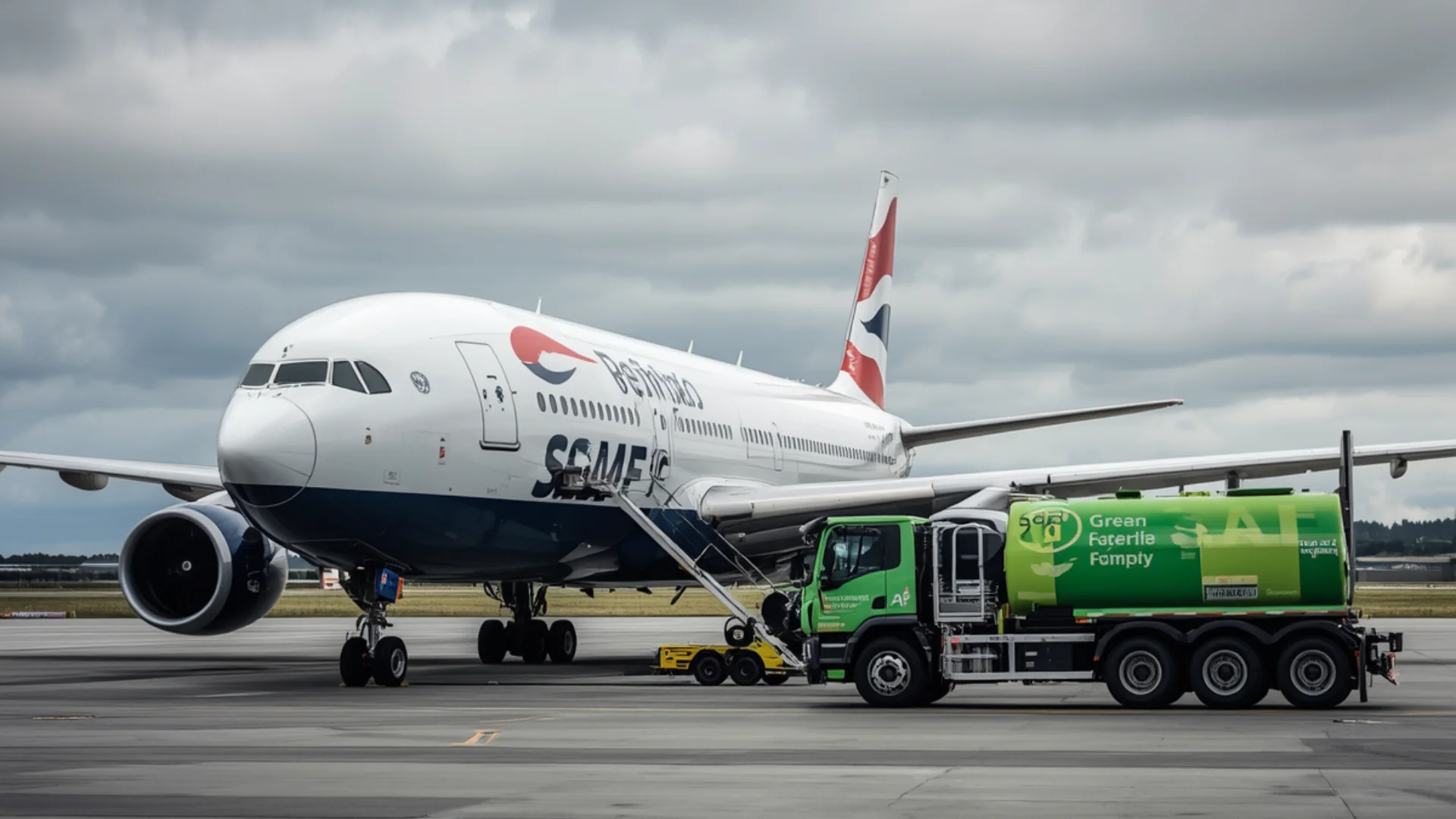
Regulatory Change | UK SAF Mandate | Aviation Decarbonization
Last Updated: May 5, 2026 | Sources: UK Parliament, DfT, House of Commons Library, Gowling WLG, Slaughter and May
Quick Summary
The United Kingdom’s Sustainable Aviation Fuel (SAF) Mandate entered force on January 1, 2025, requiring all aviation fuel suppliers delivering above a threshold volume in the UK to blend an increasing proportion of SAF into conventional jet fuel — starting at 2% in 2025, rising to 10% by 2030, and 22% by 2040. To accelerate domestic SAF production, the UK Parliament is progressing the Sustainable Aviation Fuel Bill (introduced in October 2025, Royal Assent expected by the end of 2026), which establishes a statutory Revenue Certainty Mechanism to underwrite investment in SAF production plants. Together, these measures represent the most comprehensive mandated SAF framework currently in force among English-speaking jurisdictions — and set compliance benchmarks that international airlines, fuel suppliers, and SAF producers operating in the UK must understand and plan for.
Quick Facts
| Item | Details |
|---|---|
| Authority | UK Department for Transport (DfT) |
| Mandate In Force | January 1, 2025 |
| 2025 Blending Target | 2% SAF of total aviation fuel supplied |
| 2030 Blending Target | 10% (UK) / 9.5% uplift above fossil fuel baseline |
| 2040 Blending Target | 22% |
| HEFA Cap (declining) | 100% in 2025 → 42% by 2040 |
| Certification Framework | Renewable Transport Fuel Obligation (RTFO) |
| SAF Bill Status | Lords — First Reading October 2025; Royal Assent expected end 2026 |
| Revenue Certainty Mechanism | 10-year contracts; levy on fuel suppliers |
| Non-Compliance Penalties | Up to 13x the cost of compliance |
| Applies To | UK aviation turbine fuel suppliers ≥15.9 TJ (≈468,000 litres) per year |
| Maximum Approved Blend | 50% SAF with conventional Jet A-1 (no aircraft modifications required) |
What Changed
The UK’s approach to SAF regulation combines a demand-side mandate with a new supply-side investment support mechanism.
The SAF Mandate (In Force Since January 1, 2025)
The mandate imposes two obligations on qualifying aviation fuel suppliers:
1. Main Obligation SAF must account for a minimum percentage of total fossil jet fuel supplied in the UK each year:
| Year | Minimum SAF Blend |
|---|---|
| 2025 | 2% |
| 2026 | 2% |
| 2027 | 2% |
| 2028 | ~3% (stepped increase) |
| 2030 | 10% |
| 2040 | 22% |
2. Development Fuels Sub-Target A sub-target encourages use of renewable fuels of non-biological origin (e-fuels / Power-to-Liquid SAF), supporting next-generation technology pathways beyond conventional HEFA SAF.
HEFA Feedstock Cap The mandate places a declining cap on HEFA (Hydroprocessed Esters and Fatty Acids) SAF — currently the dominant production technology globally. HEFA’s allowable share declines from 100% in 2025 to 42% by 2040, driving demand for advanced SAF feedstocks.
The Sustainable Aviation Fuel Bill (Progressing Through Parliament)
The SAF Bill introduces a statutory Revenue Certainty Mechanism (RCM) to support commercial SAF production plant investment:
- Designates a government-owned company as the contract counterparty
- Enables 10-year revenue certainty contracts between the counterparty and SAF producers
- Funds the mechanism through a levy on aviation fuel suppliers
- Imposes fines on suppliers that fail to pay the levy
- All secondary legislation implementing the RCM is targeted for completion by the end of 2026
Why the Legislation Was Enacted
The demand-without-supply problem. SAF mandates impose fuel-blending obligations, but the UK’s SAF production capacity is very limited. Without investment support, fuel suppliers face penalties for non-compliance even if eligible SAF is not commercially available at scale. The Revenue Certainty Mechanism directly addresses this by de-risking first-of-a-kind production plant investment.
Climate and net-zero commitments. The UK aviation sector is subject to legally binding net-zero obligations. SAF is the only currently scalable pathway to decarbonizing long-haul flight. The mandate framework operationalizes the policy intent behind the UK’s aviation decarbonization roadmap.
CORSIA alignment. UK aviation operators are CORSIA participants. SAF use under the UK mandate can also reduce CORSIA offsetting obligations — provided the fuel meets ICAO’s sustainability criteria, which differ from the RTFO requirements.
Competitive pressure and first-mover advantage. By establishing both a mandate and a production investment mechanism, the UK aims to attract SAF production facilities and position itself as a global SAF hub. The government has described the SAF Bill as creating a “world-leading” market.
Who Is Affected
UK Aviation Fuel Suppliers Any supplier delivering ≥15.9 terajoules (approximately 468,000 liters) of aviation turbine fuel in the UK per calendar year is subject to the mandate obligations. This threshold is deliberately set to capture commercial-scale suppliers while exempting very small operators.
Airlines Operating at UK Airports Airlines do not bear the mandate obligation directly — it falls on fuel suppliers. However, compliance costs are passed through in fuel pricing. Airlines with high UK fuel uplift volumes will see mandate cost impacts in fuel procurement pricing.
International Airlines Avoiding UK Refueling (Tankering) Airlines that carry excess fuel to avoid uplift at UK airports (tankering) currently reduce their exposure to mandate-priced fuel. Policy discussions around anti-tankering measures are ongoing.
SAF Producers: The Revenue Certainty Mechanism is specifically designed to de-risk investment in first-of-a-kind UK commercial SAF plants. Producers with planned or active UK facilities should monitor RCM implementation guidance expected by the end of 2026.
Aviation Fuel Distributors and Handling Agents. The mandate’s certification and verification requirements carry over into fuel-handling and distribution documentation.
CORSIA-Active Airlines UK-operated routes between CORSIA-participating states count toward international emissions obligations. SAF used under the UK mandate may reduce CORSIA offset requirements, subject to verification of ICAO sustainability criteria.
Compliance Timeline
| Milestone | Date |
|---|---|
| UK SAF Mandate signed into law | November 2024 |
| SAF Mandate enters force | January 1, 2025 |
| 2025 blending obligation | 2% of total aviation fuel supplied |
| SAF Bill — First Reading (Lords) | October 20, 2025 |
| SAF Bill — Royal Assent (expected) | End of 2026 |
| RCM secondary legislation complete (target) | End of 2026 |
| 2030 blending obligation | 10% |
| HEFA allowable share 2040 | 42% (down from 100% in 2025) |
| 2040 blending obligation | 22% |
Operational Impact Analysis
Non-Compliance Penalty Exposure The UK mandate carries penalties of 2 to 13 times the cost of compliance — among the most stringent non-compliance cost structures in any jurisdiction. Fuel suppliers that fail to blend the required SAF proportion face severe financial penalties, making compliance economically essential even at high SAF premiums.
HEFA Supply Constraints Global HEFA capacity — the current dominant SAF production pathway using fats, oils, and greases — faces long-term feedstock constraints. The UK’s declining HEFA cap from 2025 to 2040 requires fuel suppliers and SAF producers to invest in next-generation pathways (Fischer-Tropsch, alcohol-to-jet, Power-to-Liquid) on a defined schedule.
Revenue Certainty Mechanism — Investment Signal The RCM’s 10-year contract structure is designed to unlock Final Investment Decisions (FIDs) for new UK SAF production plants. As of 2025, no large-scale e-SAF plants had reached FID globally, with Shell having cancelled Rotterdam plans. The UK RCM targets this investment gap.
Fuel Cost Pass-Through Mandate compliance costs are passed through from fuel suppliers to airlines in uplift pricing. Airlines with significant UK operations should model the progressive cost impact of increasing blending obligations through 2030 and 2040.
RTFO Certification SAF compliance is tracked through the Renewable Transport Fuel Obligation (RTFO) Operating System certificate framework. Airlines and fuel handlers working at UK airports must ensure their supply chains generate valid RTFO certificates.
Industry ResponseThe
UK aviation industry has broadly supported the SAF mandate framework while raising concerns about supply availability and production cost. Industry bodies, including the Sustainable Aviation coalition and Airlines UK, have emphasized that the Revenue Certainty Mechanism is essential to making the mandate achievable.
IATA Director General has flagged that blending mandates without supply-side investment support can backfire: if fuel companies cannot source eligible SAF, they simply pass penalty costs to airlines without delivering environmental benefit. The RCM directly addresses this concern for the UK.
SAF producers and developers have welcomed the RCM as an enabling mechanism, but note that implementation speed matters — projects requiring FID decisions in 2026–2027 need certainty on RCM contract terms before committing capital.
Environmental groups have welcomed the mandate’s ambition but have called for faster scaling of the HEFA cap reduction and stronger enforcement of feedstock sustainability criteria.
Official Sources
- UK Department for Transport — SAF Mandate Guidance
- House of Commons Library Research Briefing — Sustainable Aviation Fuel Bill
- UK Parliament — Sustainable Aviation Fuel Act 2026 Bill Progress
- Gowling WLG — SAF Bill Revenue Certainty Mechanism Explained
- Slaughter and May — UK SAF Mandate Analysis
- UK Climate Change Act — Aviation Sector Net-Zero Framework
Action Steps
Airlines, fuel suppliers, and SAF producers operating in the UK should:
- Fuel suppliers: verify current RTFO certificate position and SAF procurement pipeline against 2025 and 2026 blending obligations — non-compliance penalties are severe
- Airlines: model progressive SAF mandate cost pass-through in UK fuel uplift pricing for 2025–2030, incorporating the mandate’s blending schedule
- SAF producers with UK production plans: engage with DfT and the designated RCM counterparty to understand contract eligibility criteria under the Revenue Certainty Mechanism; timeline secondary legislation expected by end 2026
- Legal and compliance teams: map the interaction between RTFO certification, CORSIA eligibility (ICAO sustainability criteria), and ReFuelEU Aviation requirements for routes with UK-EU connectivity
- International operators: assess tankering economics against mandate-priced UK fuel uplift — note that anti-tankering policy discussions are ongoing and may result in additional obligations
- Monitor SAF Bill progress through Parliament; Royal Assent expected by end of 2026 triggers RCM contract availability
Frequently Asked Questions
Who must comply with the UK SAF mandate? Aviation turbine fuel suppliers delivering ≥15.9 terajoules (approximately 468,000 litres) of fuel per calendar year in the UK. This applies to commercial-scale fuel suppliers at UK airports.
Do airlines bear the mandate obligation directly? No. The obligation sits with fuel suppliers. Airlines experience the mandate through SAF premium costs passed through in fuel pricing at UK airports.
What is the penalty for non-compliance? Penalties range from 2 to 13 times the cost of compliance, making the UK’s enforcement framework among the most financially punitive for non-compliant fuel suppliers in any jurisdiction.
What is HEFA and why is its cap declining? HEFA (Hydroprocessed Esters and Fatty Acids) SAF is produced from fats, oils, and greases. It is the most commercially mature SAF pathway but faces long-term feedstock supply constraints. The UK mandate’s declining HEFA cap is designed to drive investment in next-generation SAF technologies with greater feedstock diversity.
What is the Revenue Certainty Mechanism? An investment support tool established by the SAF Bill that offers 10-year revenue certainty contracts to UK SAF producers, funded by a levy on fuel suppliers. It is designed to de-risk investment in first-of-a-kind commercial SAF production plants.
Can SAF used under the UK mandate count toward CORSIA obligations? Potentially, but ICAO’s CORSIA sustainability criteria differ from the UK’s RTFO criteria. Careful verification is required. Airlines should not assume that RTFO-certified SAF automatically satisfies CORSIA eligibility requirements.
How does the UK mandate compare to the EU’s ReFuelEU? Both start at 2% in 2025. The UK reaches 10% by 2030 vs. the EU’s 6% by 2030. The UK places greater emphasis on reducing HEFA dependency. Both mandate frameworks impose non-compliance penalties, though their structures differ.
Related Updates
- ReFuelEU Aviation: EU SAF Mandate Compliance Guide — Blending Targets Through 2050
- CORSIA Phase 2 from 2027: What US Airlines Need to Prepare
- Securing America’s Fuels Act: Senate Bill to Reinstate 45Z SAF Bonus Credit
- FAA SAF Grand Challenge: Progress Toward 3 Billion Gallons by 2030
- HEFA SAF Feedstock Supply Constraints: What the Capacity Ceiling Means for Airlines
Editorial Note: This article is based on official UK Government publications, Parliamentary research briefings, and publicly available legal analysis from UK aviation law practices. The SAF Bill has not yet received Royal Assent. Mandate blending percentages, penalty structures, and RCM contract terms should be verified against current DfT guidance and RTFO operating instructions before compliance decisions are made.
Researched and reviewed using official UK Government, Parliamentary, and aviation legal sources.