Outflow valve motor failure, a freezing-fog takeoff prohibition, corroding landing-gear bolts, and a water-ingress fix for the avionics bay. Regulatory attention on the A220 is intensifying — and two of the four touch how the aircraft is flown, not just maintained.
Transport Canada · CF-2026-53 / 54 / 55EASA · AD 2026-0213All effective 4 Nov – 18 Nov 2026
Quick Answers
| Which four directives? | CF-2026-54 (outflow valve manual-mode motor), CF-2026-53 (freezing fog takeoff limitation), CF-2026-55 (landing-gear bolt sealant) from Transport Canada — and EASA AD 2026-0213 (mid avionics bay water ingress). |
|---|---|
| Which aircraft? | All are Airbus Canada BD-500 — the A220-100 (BD-500-1A10) and A220-300 (BD-500-1A11). The bolt AD is serial-number specific: 55218 through 55253, and 55255. |
| Which is the most operationally urgent? | CF-2026-53 — takeoff is prohibited in ground freezing fog with visibility below 150 metres, effective 4 November, within 7 days. |
| Why a freezing fog rule on a jet? | PW1100G-JM engines on the A320 have stalled on the ground in icing conditions. The A220’s PW1500G is a similar design, and Transport Canada will not exclude the same outcome — loss of thrust, possibly on both engines, during critical phases of flight. |
| Are these US-relevant? | Not directly — none is an FAA AD yet. But US operators of the type watch these directives because the FAA has historically adopted both TC and EASA actions for the A220. |
| What does the EASA one require? | A modification to the mid-avionics bay within 2,450 flight hours, per Service Bulletin BD500-530017. |
Quick Compliance Summary
- Operators: the freezing-fog prohibition is live. CF-2026-53 gives 7 days from its 4 November effective date. Brief dispatch and crews now; adopting the later AFM revision satisfies the rule.
- The OFV rule bites dispatch, not just maintenance. CF-2026-54 prohibits dispatch under specific MEL items and requires the AFM revision within 30 days — check your MEL relief posture immediately.
- Check serial numbers against CF-2026-55 before scheduling anything. Only 36 airframes (55218–55253 and 55255) are in scope — a 36-month window, but corrosion findings ground the aircraft before further flight.
- Plan the mid-avionics-bay modification across two visits. EASA’s 2,450-flight-hour window is generous, and the Service Bulletin explicitly allows Part A and Part B at different maintenance visits.
- Track the adoption chain. TC directives on this type routinely surface as FAA ADs; put all four on your docket-watch list.
Who Should Read This
Essential: A220 operators and CAMOs worldwide, dispatch and flight-operations teams (two of the four directives are operational), structures and systems engineers, and airworthiness managers tracking multi-authority compliance.
Important: Lessors with A220 portfolios, MEL management teams, winter-operations planners at A220 stations, and FAA-side compliance teams waiting on adoption.
At a Glance — the four directives
| Directive | Issued / Effective | Subject & required action | Applicability |
|---|---|---|---|
| CF-2026-54 ATA 21 · supersedes CF-2026-10 | Nov 3 / Nov 4 | Outflow valve manual-mode DC motor failure — dispatch prohibited under the applicable MEL items; AFM revision within 30 days (AFM issue 024, Feb 19, 2026); replacement per the directive | All BD-500-1A10 (s/n 50001+) and -1A11 (s/n 55001+) |
| CF-2026-53 ATA 71 · issued 21 Oct | Nov 3 / Nov 4 | Freezing fog limitation — takeoff prohibited in ground FZFG with visibility <150 m (500 ft), within 7 days; later AFM revision incorporating the limitation is acceptable compliance | All BD-500-1A10 and -1A11, all serial numbers |
| CF-2026-55 ATA 57 · SB BD500-572005 | Nov 2 / Nov 6 | MLG lower stabilizer fitting bolt sealant — inspect overseal on four bolts within 36 months; if missing, before further flight remove bolts and inspect for corrosion; corrosion found → before further flight, ACLP disposition, repair, replace, overseal | BD-500-1A11 s/n 55218–55253 and 55255 |
| EASA 2026-0213 ATA 53 · foreign AD: TC CF-2026-16 | Nov 4 / Nov 18 | Mid avionics bay modification within 2,450 flight hours per SB BD500-530017 Issue 001 — Part A and Part B may be done at different maintenance visits | BD-500-1A10 s/n 50001–50088; -1A11 s/n 55001–55476 |
Directive by Directive

CF-2026-54 — the outflow valve motor
During production flight tests, Airbus Canada discovered that the outflow valve’s DC motor could fail in high differential-pressure conditions. The cabin pressure control system normally runs the outflow valve with two stepper motors in automatic mode; in manual mode—used for AFM non-normal procedures, MEL relief, maintenance, and production checks—the DC motor takes over. Under high differential pressure, friction between the valve butterfly shaft and its body can demand excessive torque, tripping the manual-mode torque limiter. Result: loss of outflow valve control precisely when the crew is managing it by hand.
The directive supersedes CF-2026-10 from February, and its structure shows the escalation: a dispatch prohibition under the applicable MEL items that has applied since 13 March, and now a 30-day AFM revision mandate referencing issue 024 of the flight manual, with the affected non-normal procedures named — AUTO PRESS FAIL, CABIN ALT, unpressurised flight, window/windshield damage, smoke and fumes removal.
CF-2026-53 — the freezing fog takeoff prohibition
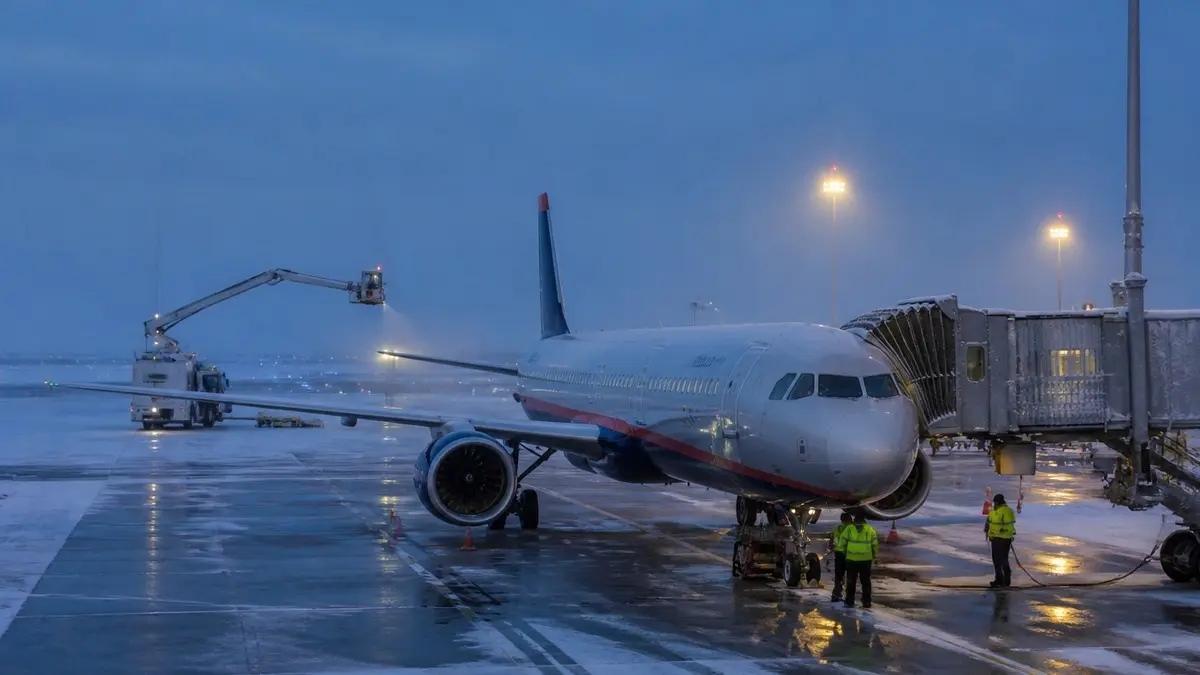
This one starts on a different aircraft. A320 operators reported PW1100G-JM engine stall events on the ground in icing weather—during acceleration to takeoff thrust or during takeoff itself. Because the A220’s PW1500G is a similar design, Transport Canada says it cannot rule out the same condition affecting it. The stated consequence if unaddressed: loss of thrust and possibly dual engine shutdown during critical phases of flight.
Airbus Canada had already issued Flight Operations Transmission A220-FOT-7200-001, recommending takeoff restrictions. This AD makes that recommendation mandatory: within 7 days of the effective date, takeoff is prohibited during ground freezing fog conditions and when visibility is below 150 metres. Incorporating a later AFM revision containing the limitation satisfies the rule. For a fleet expanding into northern European, Canadian and Asian winter operations, this is a first-order dispatch-planning item.
CF-2026-55 — the landing-gear bolts
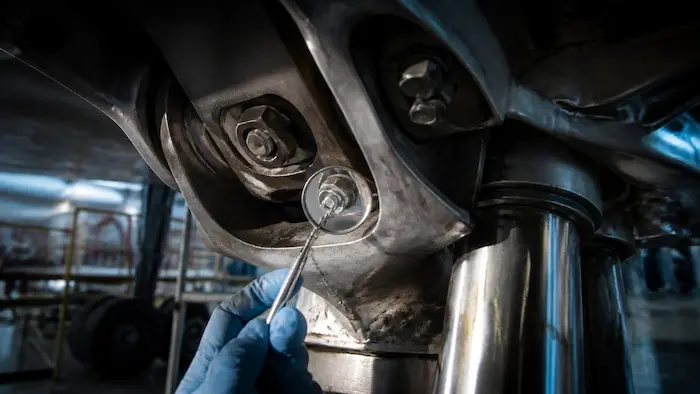
A supply shortage forced a bolt substitution on the production line: the original NAS6306 aluminium-coated stainless steel bolts on the main landing gear lower stabilizer fitting became NAS6306 passivated stainless steel bolts. But the production work instructions never picked up the engineering requirement to change the fillet seal to an overseal on the bolt heads and tails. This omission may allow moisture ingress—and where aluminium-coated fasteners met an unprotected structure, galvanic corrosion of the MLG lower stabilizer fitting became possible.
The consequence language is unusually direct for a corrosion finding: compromised structural integrity of the fitting-to-beam connection, potentially resulting in a runway excursion during takeoff. The fix is bounded — 36 airframes, serial numbers 55218 through 55253 plus 55255 — and staged: inspect the seal within 36 months; if the overseal is missing, bolts come out before further flight for a corrosion inspection; corrosion found means an Airbus Canada disposition before further flight.
EASA 2026-0213 — water in the avionics bay
Multiple in-service events saw water enter the mid avionics bay, probably from cabin water spillage. The results were multiple system losses, crew alerting messages, and flight diversions. Airbus Canada’s engineering review concluded the bay is susceptible to fluid infiltration — and that certain line-replaceable units in it are not qualified for water ingress at all.
The directive, adopting TC AD CF-2026-16, mandates the SB BD500-530017 modification within 2,450 flight hours, with an operator-friendly detail: Parts A and B of the Service Bulletin can be accomplished at different maintenance visits. Consultation ran as PAD 26-112 from 23 September to 21 October; this is the final text.
Why One Week Matters
Four directives from two authorities in five days is not noise — it is a pattern. Two of the four are operational limitations that reach into dispatch and crew procedures, not just the hangar. One traces a production-line substitution to a corrosion risk. One addresses an environmental ingress the airframe was never fully qualified against. None is dramatic alone; together they sketch an aircraft still working through early-service maturity issues across systems, structures and operations.
For compliance teams, the practical reading is a workload map: one item this week (freezing fog), one this month (OFV AFM, bolt inspection scoping), one over the next year-plus (avionics bay modification, bolt inspections). And one watch item: all four sit in the adoption pipeline toward the FAA, which has consistently followed TC and EASA on this type.
Impact Matrix
| Role | What the directives mean for you | Immediate next step |
|---|---|---|
| Flight ops / dispatch | Freezing-fog takeoff prohibition (7 days); OFV MEL relief withdrawn | Brief winter stations and revalidate MEL-based dispatch |
| CAMO / airworthiness | AFM revisions (CF-2026-54), modification planning (2026-0213) | Load all four into the compliance register with effective dates |
| Structures engineering | Bolt-seal inspection on 36 specific airframes | Match serial numbers against the affected list today |
| Maintenance planning | Mid-avionics-bay mod across 2,450 FH, splittable into two visits | Slot Part A and Part B into upcoming heavy checks |
| Lessors | Serial-number-specific exposure and compliance-status transfer | Flag s/n 55218–55253, 55255 in asset records |
| FAA-side teams | Adoption of all four is likely in due course | Add the docket references to your US watch list |
Operator Checklist
- Implement the CF-2026-53 takeoff prohibition at all affected stations within 7 days of 4 November.
- Review every A220 dispatch against the CF-2026-54 MEL prohibition — no dispatch under the named items.
- Schedule the CF-2026-54 AFM revision (issue 024) within 30 days of the effective date.
- Screen the fleet against CF-2026-55 serial numbers 55218–55253 and 55255.
- Order the SB BD500-572005 inspection for affected airframes; note the before-further-flight triggers.
- Plan the SB BD500-530017 modification against the 2,450-flight-hour window.
- Confirm the later AFM revision path to comply with both CF-2026-53 and CF-2026-54.
- Monitor the FAA docket for adoption of all four directives.
Key Dates
| Date | Event |
|---|---|
| 21 October 2026 | CF-2026-53 issued (freezing fog limitation) |
| 2–3 November 2026 | CF-2026-55 and CF-2026-54 issued; EASA 2026-0213 issued Nov 4 |
| 4 November 2026 | CF-2026-53 and CF-2026-54 effective — freezing-fog prohibition live within 7 days |
| 6 November 2026 | CF-2026-55 effective |
| 18 November 2026 | EASA 2026-0213 effective — 2,450 FH modification window opens |
ARW Take
The A220 has had a good safety record and a largely quiet directive history. Weeks like this are how that changes—not with one dramatic mandate, but with four focused ones.
The freezing-fog rule is the one that should stop operators scrolling. It is borrowed concern: an engine family on another aircraft stalled in icing; the A220’s engine is similar enough that the regulator refuses to rule it out, and the mitigation is a visibility-based takeoff prohibition that dispatch owns. Rules that reach the flight deck rather than the hangar are rarer, and they expire more slowly than inspections. The OFV rule has the same character — a dispatch prohibition wrapped around a maintenance fix.
The bolt AD is small but instructive: a supply-chain substitution changed the corrosion chemistry, but the paperwork didn’t follow, and the fix is a serial-number-specific inspection with a runway-excursion consequence statement. Watch how many other “substitution without sealant change” findings surface across the industry — this failure pattern is not A220-specific.
For A220 operators, the summary is simple: one item for dispatch this week, two for the hangar this month, one for the heavy-check planner, and all four for the FAA watch list. The type is maturing in public, and the paperwork is the record.
Sources
- Transport Canada AD CF-2026-54 — Air Conditioning, Outflow Valve Manual Mode DC Motor Failure (issued Nov 3, 2026; effective Nov 4, 2026) — directive PDF
- Transport Canada AD CF-2026-53 — A220 Freezing Fog Limitation (issued 21 October 2026; effective Nov 4, 2026) — directive PDF
- Transport Canada AD CF-2026-55 — Potential Incorrect Sealant Application on Lower Stabilizer Fitting Bolts (issued Nov 2, 2026; effective Nov 6, 2026) — directive PDF
- EASA AD 2026-0213 — Fuselage, Mid Avionics Bay, Modification (issued Nov 4, 2026; effective Nov 18, 2026; foreign AD: TC CF-2026-16) — easa.europa.eu
FAQ
Do any of these apply to US-registered A220s today?
Not as FAA ADs — these are Transport Canada and EASA directives. Operators of US-registered aircraft should check their lease and maintenance agreements: many require compliance with the state-of-design authority’s ADs regardless of registry. Expect FAA adoption to follow.
What if my station routinely sees freezing fog with visibility below 150 m?
Then the CF-2026-53 prohibition is a schedule driver, not an edge case. Dispatch needs alternate departure planning or holds, because takeoff is prohibited in those conditions until the AFM revision path is in place — and note the AFM route changes the limit’s legal basis, not its substance.
Why does CF-2026-55 mention a supply shortage?
Production substituted the bolts because the original aluminium-coated variant was unavailable. The substitute’s corrosion protection differs, and the sealing requirement that accompanied the change was never written into the work instructions. The AD closes that gap on 36 airframes.
Can the mid-avionics-bay modification be deferred past 2,450 flight hours?
Only through an approved Alternative Method of Compliance from EASA. The directive itself sets the limit, though it explicitly allows the two Service Bulletin parts at separate maintenance visits.
Related Posts
- FAA AD 2026-15-13: Airbus A319/A320/A321 NEO Family — HPV Butterfly Seal Clip Repetitive Replacement Now Required
- EASA Grounds the Entire Elixir Fleet After a Fatal Accident — and the FAA Follows
AviationRegWatch publishes regulatory intelligence for aviation compliance professionals. This article is an informational summary of published regulatory actions, not legal or airworthiness advice. Always verify requirements against the official Transport Canada and EASA publications, and consult your CAMO or national authority before making compliance decisions. Spotted an error or an outdated detail? Let us know, and we will verify and correct it.