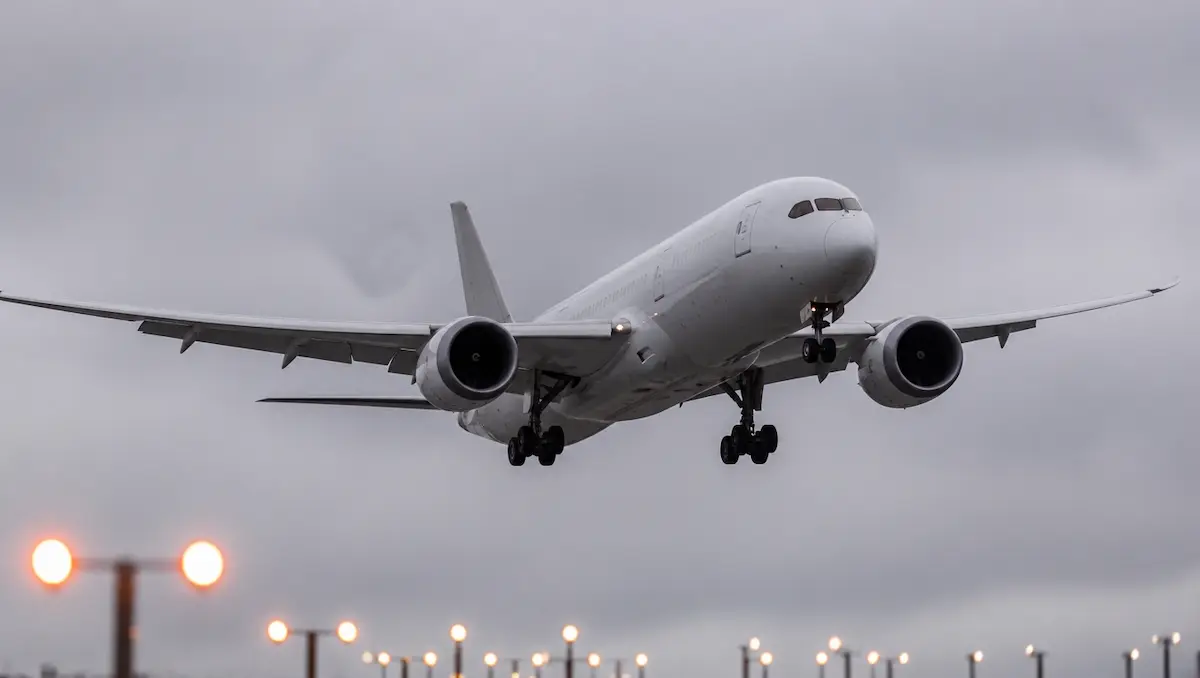
The 787’s low-range radio altimeter has been dropping valid data at low altitude on approach. The fix is not a software patch but new coaxial cable on both sides on 169 US-registered airplanes. Operators have five years from 14 December 2026.
FAA AD 2026-22-09 · FR Doc. 2026-22817Effective 14 December 2026169 US-registered airplanes
Quick Answers
| Which airplanes are affected? | Boeing 787-8, 787-9 and 787-10 airplanes, certificated in any category, as identified in Boeing Alert Requirements Bulletin B787-81205-SB340062-00 RB, Issue 001, dated 23 December 2024. |
|---|---|
| What is the problem? | The low range radio altimeter (LRRA) system produces an increased rate of non-computed data (NCD) outputs at low altitudes during approach and landing, which can make the altimeter output unreliable. |
| What must operators do? | Replace the left and right LRRA transmit and receive coaxial cables — currently BMS13-65 Type 0G — with larger gauge Type 0J cable, per the Boeing Requirements Bulletin. |
| When does it take effect? | 14 December 2026. Compliance times in the bulletin are re-anchored to that date, not to the December 2024 bulletin issue date. |
| How long do I have? | Five years. The FAA explicitly refused requests to extend it, and refused a request to shorten it. |
| What does it cost? | The FAA estimates $17,805 per airplane — 31 work-hours at $85 plus $15,170 in parts. Fleet total: $3,009,045. |
| Is there any relief? | Yes. The AD says “unless already done”; later approved service bulletin issues may be used, and AMOCs run through AIR-520. |

Quick Compliance Summary
- Check applicability against the bulletin, not the model name. The AD covers 787-8, -9 and -10 “as identified in” Boeing Alert Requirements Bulletin B787-81205-SB340062-00 RB, Issue 001. Group position decides your task, not whether you fly a 787.
- Your clock starts 14 December 2026. Paragraph (h) replaces every reference to the Requirements Bulletin issue date with the AD’s effective date. This is the single most useful line in the rule.
- Order cable now, not later. American Airlines told the FAA that Boeing quoted a lead time exceeding 500 days. The FAA declined to extend compliance anyway.
- Use Issue 002 of the service bulletin where it helps. Issue 002, dated 11 August 2025, updates work instructions for Group 4 airplanes, revises task tables and illustrations, and corrects kit and consumable content. The FAA accepts it for compliance.
- Do not wait for Requirements Bulletin Issue 002. Boeing has not released one, and the FAA says the Issue 002 service bulletin changes do not affect the required-for-compliance steps in Issue 001 of the RB.
- Budget $17,805 per tail. Parts are 85% of that number, which is why the supply chain — not labour — is the schedule risk.
- Log it as a modification, not a check. This changes the aircraft’s wiring installation. Update the maintenance programme, EWIS documentation, and the weight-and-balance record, as applicable.
Who Should Read This
Essential: 787 operators and fleet managers, CAMOs and maintenance planning teams, avionics and electrical systems engineers, and Part-145 organisations holding 787 capability.
Important: Flight operations and safety managers on the type; training organisations teaching 787 approach and autoland procedures; lessors tracking 787 asset condition; and supply chain teams responsible for Boeing kit orders.
At a Glance
| Element | Detail |
|---|---|
| Rule | AD 2026-22-09 — final rule, 14 CFR Part 39 |
| Identifiers | FR Doc. 2026-22817 · Docket FAA-2026-1335 · Project AD-2025-00825-T · Amendment 39-23511 |
| Publication | Federal Register Vol. 91, No. 215, pages 70774–70776, 9 November 2026 |
| Effective | 14 December 2026 |
| Applicability | Boeing 787-8, 787-9, 787-10 as identified in the Boeing Requirements Bulletin |
| ATA chapter | 34 — Navigation |
| Incorporated document | Boeing Alert Requirements Bulletin B787-81205-SB340062-00 RB, Issue 001, 23 December 2024 |
| Unsafe condition | LRRA NCD outputs at low altitude → unreliable altimeter function → possible loss of continued safe flight and landing |
| Required action | Replace left and right LRRA transmit and receive coaxial cables (Type 0G → Type 0J) |
| Compliance period | 5 years from the AD effective date |
| US fleet cost | $17,805 per airplane; $3,009,045 across 169 airplanes |

What Happened
Operators reported a pattern the FAA could not ignore. On approach and landing—the phase where radio altitude matters most—the 787’s low-range radio altimeter produced an elevated rate of non-computed data outputs. NCD is what an altimeter says when it cannot compute a trustworthy answer. The system is not reporting a height; it is reporting that it does not know the height.
The FAA’s investigation traced the behaviour to the coaxial cable runs that carry the LRRA transmit and receive signals. The installed cable is BMS13-65 Type 0G. Boeing’s fix is to replace both the left and right transmit and receive runs with the larger gauge Type 0J cable, which improves signal integrity across the run.
The agency proposed the rule on 24 February 2026 at 91 FR 8794. Comments came in from ALPA and Boeing supporting the proposal without change, and from Air Canada, American Airlines, EVA Air, the Foundation for Aviation Safety, Turkish Airlines, United Airlines and one anonymous commenter. The final rule adopts the proposal essentially unchanged, with editorial corrections and a revised cost section reflecting updated work-hours in Issue 002 of the service bulletin.
What the AD Requires
Paragraph (g) is deliberately short. Operators must, at the times set out in the Compliance paragraph of the Boeing Requirements Bulletin, accomplish all applicable actions in the Accomplishment Instructions of that same document. The AD does not restate the procedure; it incorporates the bulletin by reference and makes the bulletin’s timeline legally binding.
Paragraph (h) is where the practical detail sits, and it is easy to miss. Where the bulletin’s compliance tables count from the issue date of the Requirements Bulletin — 23 December 2024 — the AD requires operators to count from the AD’s effective date instead. In plain terms, the clock resets to 14 December 2026. Operators who assumed they were already a year and a half into a five-year window are not.
Two further provisions matter to maintenance control. Paragraph (i) routes alternative compliance methods through the Manager, AIR-520, Continued Operational Safety Branch, and also permits the Boeing Organization Designation Authorization to approve repairs, modifications, or alterations that meet the type’s certification basis and explicitly reference this AD. Paragraph (k) formally incorporates the Requirements Bulletin under 1 CFR Part 51, which means the bulletin is not guidance — it is the regulation’s operative text.
Why This Is an Airworthiness Action
Radio altitude is not a convenience display. Several safety-critical functions depend on it during the last two hundred feet of flight. Autoland flare and rollout logic, ground proximity warning, windshear alerting, and traffic advisory logic all consume radio altitude. When the source degrades, those functions do not fail loudly. They degrade quietly, and quiet degradation on a low-visibility approach is the worst kind.
The FAA’s stated end state is unambiguous: “loss of continued safe flight and landing.” The agency doesn’t use that language for cosmetic defects. It reserves that phrase for conditions that can end a flight rather than inconvenience one.
The compliance period deserves its own note. Five years looks generous for a cable change until you price it. At $17,805 per airplane, with $15,170 of that in parts, the constraint isn’t hangar time—it is kit availability against a global widebody fleet that all needs the same part. The FAA was told exactly this and declined to move. That tells you the agency views the risk as manageable within five years but not as one that can wait for a natural maintenance cycle across the whole fleet.
What the Commenters Changed — and What They Did Not
Three requests dominated the comment record, and the agency refused all three. Understanding why is useful for anyone planning the work.
The extension request failed. American, Turkish Airlines, and an anonymous commenter asked for more time. American cited Boeing’s lead time for the required cables as exceeding 500 days. Turkish said it shared kit needs with Boeing in March 2025 and still hit supply problems. The FAA said it considered manufacturer recommendations, urgency, parts availability, and normal scheduled maintenance, and that operators have sufficient time within five years. It then pointed to paragraph (i) and noted it will consider individual extensions where an operator submits data showing an acceptable level of safety. That is the practical route for anyone genuinely blocked by supply — an AMOC or extension request with evidence, not a comment to the docket.
The shortening request failed. The Foundation for Aviation Safety argued the condition is critical and questioned whether five years was appropriate for work estimated at roughly 28 hours. The FAA kept five years.
The visual-flight-rules exemption failed. An anonymous commenter asked that affected airplanes be allowed to continue on routes where departure and arrival airports are forecast VFR, on the logic that pilots then rely on visual reference rather than radio altitude. The FAA disagreed on two grounds: the cables must be replaced to address the unsafe condition, and the LRRA is needed for everyday operations regardless of forecast. It also made a point worth repeating — the AD does not prohibit operation of affected airplanes.
On service information, the FAA accepted one request and refused another. It agreed that Issue 002 of the service bulletin, dated 11 August 2025, may be used to accomplish the required actions, since Tables 1 and 2 of Issue 001 of the Requirements Bulletin accept later approved service bulletin issues. It disagreed with EVA Air and Turkish Airlines on recognising Requirements Bulletin Issue 002 because the service bulletin’s Issue 002 does not change the required-for-compliance steps, and Boeing has not released a matching RB revision.
Impact Matrix
| Role | What the AD means for you | Immediate next step |
|---|---|---|
| Operator / fleet manager | Mandatory cable replacement on every in-scope 787, with a five-year window from 14 December 2026 | Confirm each tail’s group position in the Requirements Bulletin this week |
| Maintenance planning | 31 work-hours per airplane, but kit-dependent | Build the replacement into the next heavy check, not a line visit |
| Avionics / electrical engineering | Type 0G to Type 0J cable change on four runs per airplane | Verify routing, clamping and separation requirements from Issue 002 of the SB |
| Supply chain / procurement | Cable kits are the schedule constraint; lead time has been quoted above 500 days | Place orders against the full fleet now, not per tail |
| Part-145 organisations | New task on the type, with incorporation-by-reference documentation | Add the task card and train certifying staff on the AD’s paragraph (h) date shift |
| Flight operations | LRRA degradation can affect approach and landing functions before any cockpit indication appears | Ensure NCD-related crew reports reach engineering, not just the tech log |
| Lessors / asset teams | Compliance status travels with the airframe | Request AD 2026-22-09 evidence at redelivery and in lease return conditions |
| Continuing airworthiness / CAMO | Incorporation by reference, plus a five-year compliance horizon | Enter the AD in the compliance register with the 14 December 2026 anchor |
Operator Checklist
- Obtain Boeing Alert Requirements Bulletin B787-81205-SB340062-00 RB, Issue 001, dated 23 December 2024.
- Map every 787 in your fleet to its group in that bulletin, and record which required-for-compliance steps apply.
- Confirm which airplanes, if any, have already accomplished the replacement, and evidence it — the AD applies “unless already done.”
- Re-anchor every compliance due date to 14 December 2026 in line with paragraph (h), and discard any plan built on the December 2024 bulletin date.
- Place cable kit orders based on total fleet need, and document the quoted lead time.
- Obtain Issue 002 of the service bulletin, dated 11 August 2025, and use its revised work instructions for Group 4 airplanes.
- Schedule replacement into heavy maintenance where possible — 31 work-hours does not fit a turnaround.
- Update the maintenance programme, task cards, EWIS documentation and records to reflect the installed Type 0J cable.
- Brief certifying staff that the Requirements Bulletin, not the service bulletin, carries the required-for-compliance steps.
- If supply genuinely blocks you, prepare an AMOC or extension request with data for AIR-520 — do not assume a docket comment will move the date.
Key Dates
| Date | Event |
|---|---|
| 23 December 2024 | Boeing Alert Requirements Bulletin B787-81205-SB340062-00 RB, Issue 001 issued — the document the AD incorporates |
| 11 August 2025 | Service bulletin Issue 002 issued; accepted by the FAA for compliance, particularly for Group 4 airplanes |
| 24 February 2026 | FAA NPRM published, 91 FR 8794 |
| 9 November 2026 | Final rule published, FR Doc. 2026-22817 |
| 14 December 2026 | AD effective — incorporation by reference applies and compliance times re-anchor to this date |
| 14 December 2031 | End of the five-year compliance period for a task not otherwise scheduled earlier by the bulletin |
ARW Take
This is a well-built rule, but one line will be misread across the industry. Paragraph (h) resets the compliance clock to 14 December 2026. Any operator whose planning spreadsheet still counts from 23 December 2024 has built a schedule that is nineteen months short — and it will look conservative until the review that catches it.
The second point is that this is a parts problem in engineering clothes. Hardware makes up 85 per cent of the FAA’s per-airplane cost. American Airlines put a 500-day lead time on the record; Turkish Airlines said kits it had asked for in March 2025 still haven’t arrived, and the FAA refused to move the date anyway. That combination — constrained supply, immovable deadline, whole-fleet demand — is how a five-year compliance period quietly becomes a three-year crunch. Order early, and treat your kit order book as the real compliance metric.
The third point is the honest one about severity. Five years and no operating restriction tell you the FAA does not consider this an immediate grounding risk. But “loss of continued safe flight and landing” is in the unsafe-condition paragraph, and LRRA feeds functions that crews rely on precisely when they cannot see outside. The right posture is neither panic nor deferral: schedule it, order it, and stop treating an NCD event as a nuisance log entry.
One structural observation for anyone tracking the 787. This is the second airworthiness action on the type in this sweep — the centre fuel tank sealant AD, 2026-22-08, was published a week earlier with a 7 December effective date. Two unrelated systems, two independent findings, eight days apart. Neither indicates a fleet-wide problem. Together, they indicate an active, continued-operational-safety pipeline on a young widebody, which is exactly what you want to see and should resource for.
Sources
- FAA, Airworthiness Directives; The Boeing Company Airplanes — AD 2026-22-09, FR Doc. 2026-22817, 91 FR 70774 (9 November 2026) — federalregister.gov
- FAA NPRM, 91 FR 8794 (24 February 2026) — Docket FAA-2026-1335
- Boeing Alert Requirements Bulletin B787-81205-SB340062-00 RB, Issue 001, dated 23 December 2024 (incorporated by reference at 1 CFR Part 51)
- Boeing Alert Service Bulletin B787-81205-SB340062-00, Issue 002, dated 11 August 2025 — accepted for compliance
- FAA, Airworthiness Directives; The Boeing Company Airplanes — AD 2026-22-08 (center fuel tank sealant), FR Doc. 2026-22318, 91 FR (2 November 2026) — federalregister.gov
FAQ
Does this AD ground 787s until the cables are changed?
No. The AD does not prohibit operation. It sets compliance times through the incorporated Requirements Bulletin. The FAA said this explicitly when refusing a request to allow continued VFR-only operation.
My maintenance plan counts from December 2024. Is it wrong?
Yes, on the compliance date. Paragraph (h) replaces references to the Requirements Bulletin issue date with the AD’s effective date of 14 December 2026. Re-anchor your due dates.
Can I use the newer service bulletin, Issue 002?
Yes. The FAA agreed that Issue 002, dated 11 August 2025, may be used to accomplish the required actions, and it corrects kit and consumable content plus work instructions for Group 4 airplanes.
Is there a Requirements Bulletin Issue 002?
No. Boeing has not released one. The FAA declined to require it because Issue 002 of the service bulletin does not change the required-for-compliance steps.
What if Boeing cannot supply the cables in time?
Request an alternative method of compliance or a compliance-time extension through the Manager, AIR-520, Continued Operational Safety Branch, under 14 CFR 39.19, with data showing an acceptable level of safety. Commenting on the docket is not the mechanism.
Does this apply to 787s outside the United States?
The AD is FAA jurisdiction over US-registered airplanes. Other authorities normally adopt or mirror it — EASA and Transport Canada have parallel processes. Operators elsewhere should check their own authority’s adoption notice rather than assume the FAA date applies.
Is the cost per airplane or per cable run?
Per airplane. The FAA’s figure of $17,805 covers the full action — 31 work-hours at $85 plus $15,170 in parts — and totals $3,009,045 across 169 US-registered airplanes. The manufacturer may cover some or all of that under warranty.
Related Posts
- FAA Orders DA40 Door Inspections After In-Flight Door Separations
- FAA Proposes Fleet-Wide CFM56-7B Fan Blade Inspection After In-Flight Separation
- FAA AD 2026-20-14: 737NG Stabilizer Freeplay Checks Explained
AviationRegWatch publishes regulatory intelligence for aviation compliance professionals. This article is an informational summary of a published final rule, not legal or airworthiness advice. Always verify requirements against the official Federal Register text and the incorporated Boeing Requirements Bulletin, and consult your CAMO or the FAA before making compliance decisions. Spotted an error or an outdated detail? Contact us, and we will verify and correct it promptly.