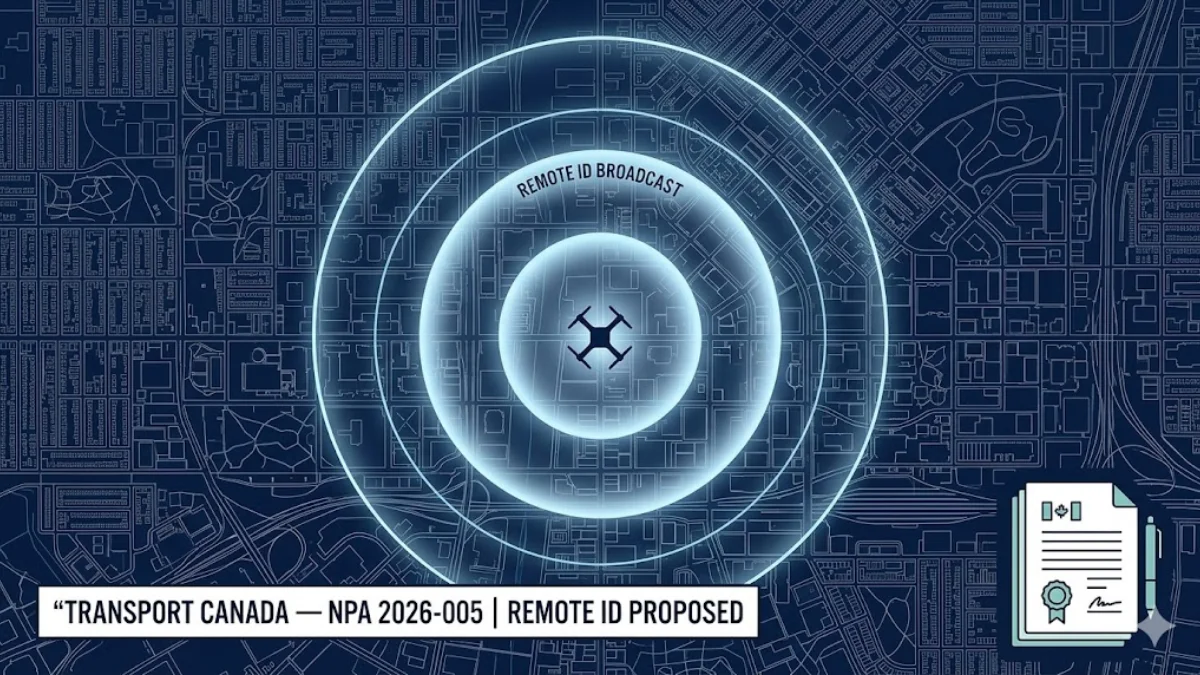
Regulator | Transport Canada | Drones & UAS NPA Published: 8 June 2026 | Comment Deadline: 9 September 2026
QUICK READ
Transport Canada published NPA 2026-005 on June 8, 2026 — the most significant proposed rewrite of Canadian drone rules since 2019. The proposal mandates Remote ID for most drone operations, creates a formal Community-Based Organization model with Fixed Site exemptions, and introduces new powers to restrict airspace below 122 meters. The comment window closes September 9, 2026.
QUICK SUMMARY
| Item | Detail |
|---|---|
| Instrument | Notice of Proposed Amendment NPA 2026-005 |
| Authority | Transport Canada / Canadian Aviation Regulation Advisory Council (CARAC) |
| Published | 8 June 2026 |
| Topic | Drones & UAS |
| Status | Proposed regulation — open for public comment |
| Comment Deadline | 9 September 2026 |
| Who Is Affected | All RPAS operators (commercial and recreational), Community-Based Organisations (model aircraft clubs, recreational groups, academic institutions), airspace authorities |
| Regulatory Basis | Canadian Aviation Regulations (CARs) Part IX |
What Transport Canada Has Proposed
Transport Canada published Notice of Proposed Amendment NPA 2026-005 on 8 June 2026. The NPA was distributed through the Canadian Aviation Regulation Advisory Council (CARAC) subscriber system.
This is the most significant proposed rewrite of Canadian drone regulations since Part IX of the Canadian Aviation Regulations came into effect in 2019. It follows the two-phase RPAS modernization completed in April and November 2025, which introduced BVLOS operational rules and new certification levels for larger drones.
NPA 2026-005 contains three distinct regulatory proposals.
Proposal 1: Mandatory Remote ID for Most RPAS Operations
Remote ID is the core proposal in this NPA. Transport Canada is proposing that operators of most drones be required to transmit Remote ID data during flight.
Remote ID functions as a digital identifier for a drone in flight. It transmits the aircraft’s identity, its real-time position, and the location of its ground control station. This data can be received by authorities and airspace management systems without requiring the drone pilot to take any action during the flight.
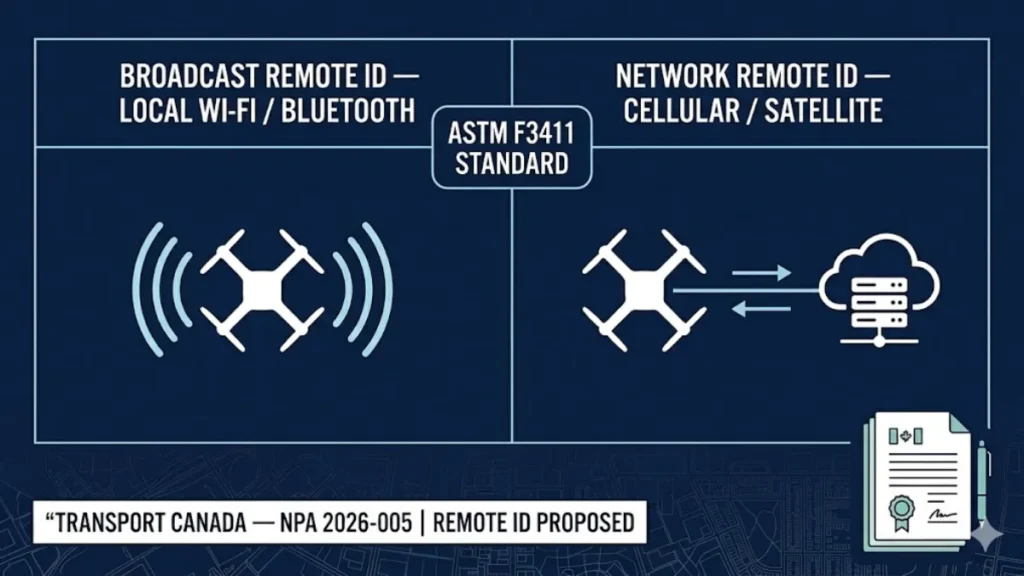
Performance-based approach: Transport Canada is not prescribing a single technology. The proposal accepts two technical paths:
- Broadcast Remote ID — transmits data locally over Wi-Fi or Bluetooth to receivers within range
- Network Remote ID — streams data over cellular or satellite connections to a central system
Both paths must be built on the ASTM F3411 international consensus standard. This approach departs from the US FAA model, which mandated broadcast-only Remote ID (Part 89, enforced from March 2024) after rejecting network Remote ID following public comment.
Weight and category scope: The mandate applies to the drone categories established in the 2025 RPAS overhaul — from 250 grams up to 150 kilograms. Micro-drones below 250 grams are not included.
Tampering prohibition: The NPA introduces strict prohibitions on altering, disabling, or interfering with a functioning Remote ID broadcast or manufacturer-installed geo-awareness software. Administrative monetary penalties are proposed for violations.
Legacy fleet considerations: Transport Canada acknowledges that mass-market drones currently in use may not receive Remote ID firmware updates from manufacturers. The proposal does not penalize legacy systems that pre-date the requirement, but operators of non-compliant legacy drones will need to plan for fleet transitions.
Proposal 2: Community-Based Organization (CBO) Framework
The NPA creates a formal regulatory category for Community-Based Organizations. This category is designed to accommodate model aircraft clubs, recreational flying groups, and academic institutions with established flying sites and safety frameworks.
What qualifies as a CBO: The NPA proposes criteria for non-commercial groups to apply for formal CBO status. Eligible organizations must demonstrate organized safety oversight of their members.
Fixed Sites — Remote ID exemption: Once a CBO achieves approved status, its national representatives may designate permanent Fixed Sites where Remote ID is not required for member operations. This recognizes that established flying clubs with controlled, bounded sites present a different risk profile from unstructured public drone operations.
Implications for compliance professionals: MRO organizations, ATOs, and any aviation institution that operates drones for training or research may be eligible for CBO status. The framework offers a pathway to structured operational authorization that is lighter than a full Specific Category approach.
Proposal 3: New Designated Airspace Restriction Powers
The third proposal gives Transport Canada a purpose-built regulatory tool to restrict drone operations in airspace below 122 meters (400 feet). This altitude band is not currently covered by a specific restriction mechanism in the CARs.
The proposed power is intended to address situations where temporary or permanent restrictions are needed in low-altitude airspace — for example, near sensitive infrastructure, during major public events, or in response to security requirements — without relying on existing NOTAMs or airspace mechanisms that were designed for manned aviation.
Pilots must continue to check for airspace restrictions before flight using authorized tools such as NAV Drone or the Drone Site Selection Tool (DSST).
Regulatory Context
This NPA lands at the intersection of two trends in Canadian drone regulation.
First, the 2025 RPAS modernization opened routine BVLOS operations and created new pilot certification levels. That reform expanded where and how drones can legally operate. Remote ID is the accountability mechanism that makes expanded access sustainable — regulators and authorities need a way to identify aircraft operating in shared airspace.
Second, Transport Canada anticipates an ICAO Universal Security Audit Program review of Canada’s aviation security framework in 2026. Remote ID and improved airspace control tools align with international aviation safety and security standards.
Compliance Action Summary
| Action | Who | Priority |
|---|---|---|
| Review NPA 2026-005 and assess Remote ID compliance requirements against current fleet | All RPAS operators (commercial and institutional) | Immediate — comment window is open |
| Submit written comment to Transport Canada via CARAC portal by 9 September 2026 | All affected operators | Before 9 September 2026 |
| Assess legacy fleet for Remote ID compatibility | All RPAS operators | Before final regulation is published |
| Evaluate eligibility for Community-Based Organisation status | Model aircraft clubs, academic institutions, ATOs with drone programmes | Before final regulation |
| Review low-altitude airspace restriction implications for planned operations | All RPAS operators in Canada | Ongoing |
Comment submission: Written comments must be submitted via the official Transport Canada CARAC portal by September 9, 2026.
Transport Canada RPAS Remote ID 2026: FAQs
Q: What is NPA 2026-005 and what does it propose?
NPA 2026-005 is a Notice of Proposed Amendment published by Transport Canada on June 8, 2026. It proposes three changes to the Canadian Aviation Regulations: mandatory Remote ID for most drone operations, a new Community-Based Organization framework with Fixed Site exemptions from Remote ID, and new regulatory powers to restrict drone airspace below 122 meters.
Q: Is Remote ID already required for drones in Canada?
No. Remote ID is not currently required under the Canadian Aviation Regulations. NPA 2026-005 is a proposal at the consultation stage. It does not have legal effect until it is published in the Canada Gazette and enacted as a final regulation.
Q: What is the difference between Broadcast Remote ID and Network Remote ID?
Broadcast Remote ID transmits a drone’s identity and position data locally over Wi-Fi or Bluetooth to receivers within range. Network Remote ID streams the same data over cellular or satellite connections to a central system. Transport Canada’s proposal accepts both methods, provided they meet the ASTM F3411 technical standard. The FAA’s equivalent rule in the United States requires broadcast-only Remote ID.
Q: Will existing drones need to be replaced to comply with Remote ID requirements?
Not necessarily. Some existing drones may receive firmware updates from manufacturers that add Remote ID capability. Others may not. Transport Canada acknowledges that some mass-market legacy drones may become non-compliant when the final rule takes effect. Operators should check with their drone manufacturer on update availability and plan fleet transitions accordingly.
Q: What is a Community-Based Organization (CBO) under the proposed rules?
A CBO is a formally recognized non-commercial organization — such as a model aircraft club, recreational flying group, or academic institution — that meets eligibility criteria and applies for CBO status from Transport Canada. Approved CBOs can designate permanent Fixed Sites where their members may operate without Remote ID.
Q: What is the deadline to comment on NPA 2026-005?
Written comments must be submitted to Transport Canada via the CARAC portal by 9 September 2026.
Related Reading
Editorial note: This article is based on Transport Canada’s Notice of Proposed Amendment NPA 2026-005, published 8 June 2026 via the Canadian Aviation Regulation Advisory Council (CARAC). NPA 2026-005 is a proposed regulation and has no legal effect until enacted as a final regulation in the Canada Gazette, Part II. Compliance professionals and operators should review the full NPA text via the CARAC portal and submit comments before 9 September 2026. Fleet compatibility with Remote ID requirements should be assessed with reference to individual aircraft manufacturer guidance.
Researched and reviewed using official Transport Canada, CARAC, and Canada Gazette sources.